

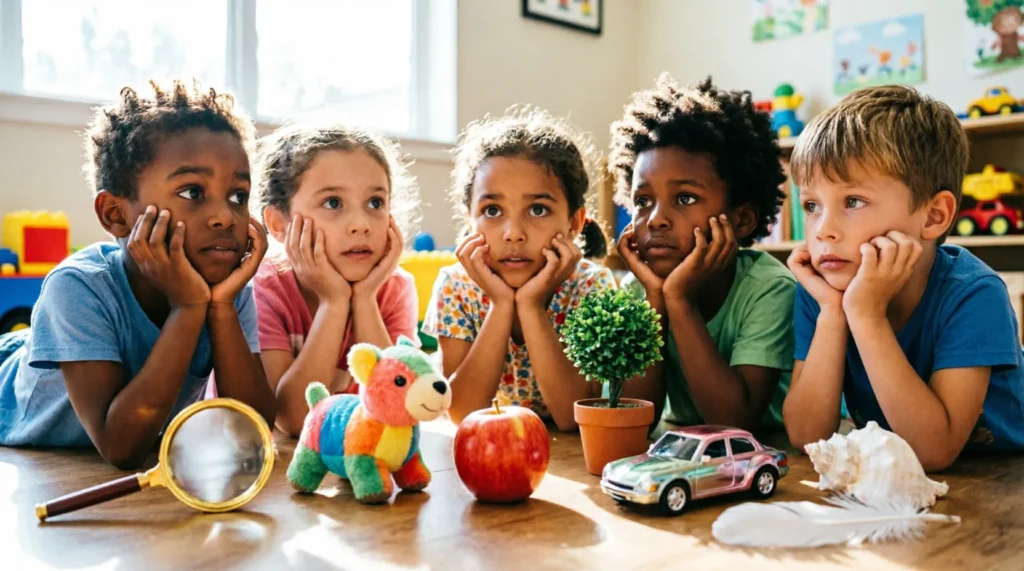
What am I riddles for 6 year olds are the perfect way to spark curiosity and laughter at the same time. These playful puzzles challenge young minds to think creatively while keeping the answers simple enough that success feels achievable. Whether you’re a parent looking for rainy-day activities or a teacher planning circle time, this collection delivers riddles that six-year-olds actually enjoy solving.
Top 5 What Am I Riddles for 6 Year Olds
I have no voice, but I can tell you stories. I have no legs, but I travel the world. What am I? Answer: A book
I’m tall when I’m young and short when I’m old. What am I? Answer: A candle
I have hands but can’t clap. What am I? Answer: A clock
I have a face but no eyes, and hands but no arms. What am I? Answer: A clock
I get wet while drying. What am I? Answer: A towel
Easy What Am I Riddles
These gentle starters build confidence. When I test these with first-graders, nearly every child gets at least three right on the first try.
I’m orange, I live in the ground, and rabbits love to eat me. What am I? Answer: A carrot
I have keys but no locks. I have space but no room. You can enter but not go inside. What am I? Answer: A keyboard
I’m full of holes but still hold water. What am I? Answer: A sponge
I go up but never come down. What am I? Answer: Your age
I have a neck but no head. What am I? Answer: A bottle
I’m light as a feather, but even the strongest person can’t hold me for long. What am I? Answer: Breath
I have teeth but can’t bite. What am I? Answer: A comb
I’m not alive, but I can grow. I don’t have lungs, but I need air. What am I? Answer: Fire
I have one eye but can’t see. What am I? Answer: A needle
I can be cracked, made, told, and played. What am I? Answer: A joke
Animal What Am I Riddles
Six-year-olds are usually animal experts, so these riddles feel familiar and fun. animal-themed puzzles consistently rank as favorites among young children because they connect to what kids already know and love.
I have a long trunk but I’m not a car. I have big ears and I never forget. What am I? Answer: An elephant For more, see 130 Clever Riddles for Smart Kids (With Answers).
I say “moo” and give you milk. What am I? Answer: A cow
I have stripes and I’m orange and black. I say “roar!” What am I? Answer: A tiger
I live in the ocean, I’m very big, and I sing songs. What am I? Answer: A whale
I have a pouch for my baby. I hop around Australia. What am I? Answer: A kangaroo
I’m black and white and I slide on my belly. What am I? Answer: A penguin
I have a shell on my back and I move very slowly. What am I? Answer: A turtle
I spin webs and catch flies. What am I? Answer: A spider
I have a mane but I’m not a lion. People ride me. What am I? Answer: A horse
I say “ribbit” and I love to jump. What am I? Answer: A frog
Funny What Am I Riddles
These silly riddles get giggles every time. The wrong answer is often funnier than the right one, which is half the fun.
What has a bottom at the top? Answer: Your legs
What can you catch but not throw? Answer: A cold
What goes up and down but doesn’t move? Answer: Stairs
What has a head and a tail but no body? Answer: A coin
What can travel around the world while staying in a corner? Answer: A stamp
What gets sharper the more you use it? Answer: Your brain
What has words but never speaks? Answer: A book
What can you break without touching it? Answer: A promise
What belongs to you but others use it more? Answer: Your name
What can fill a room but takes up no space? Answer: Light
Tricky What Am I Riddles
These require a bit more thinking. When I run these with six-year-olds, the most common wrong guess for riddle #3 is “a shadow,” which actually makes sense until you think about it more carefully.
The more you take, the more you leave behind. What am I? Answer: Footsteps
I have cities but no houses. I have mountains but no trees. I have water but no fish. What am I? Answer: A map
I follow you all day, but when the night or rain comes, I still disappear. What am I? Answer: A shadow
What can you hold in your left hand but not in your right? Answer: Your right hand
What has many keys but can’t open a single lock? Answer: A piano
What can you see in the middle of March and April but not at the beginning or end of either month? Answer: The letter “R”
What comes once in a minute, twice in a moment, but never in a thousand years? Answer: The letter “M”
What can you keep after giving it to someone? Answer: Your word
Short What Am I Riddles
Perfect for quick brain breaks or car rides. These are concise enough that six-year-olds can remember them and share with friends. For more, see Riddle.
What has to be broken before you can use it? Answer: An egg
What month of the year has 28 days? Answer: All of them
What is always coming but never arrives? Answer: Tomorrow
What is so fragile that saying its name breaks it? Answer: Silence
What can you hold without ever touching it? Answer: A conversation
What runs but never walks? Answer: Water
What has a ring but no finger? Answer: A telephone
What goes through cities and fields but never moves? Answer: A road
Food What Am I Riddles
Kids love food riddles because the answers are tasty. These work especially well around snack time or lunch.
I’m yellow and curved. Monkeys love me. What am I? Answer: A banana
I’m red and juicy. I grow on vines. What am I? Answer: A tomato
I come from a cow but I’m not meat. I’m white and good on cookies. What am I? Answer: Milk
I’m round and cheesy. People love me on Fridays. What am I? Answer: A pizza
I’m sweet and sticky. Bees make me. What am I? Answer: Honey
I’m green and bumpy. Some people put me on sandwiches. What am I? Answer: An avocado
I’m crunchy and orange. I grow in the ground. What am I? Answer: A carrot
I’m fluffy and white. You eat me with butter. What am I? Answer: Popcorn
How to Use These Riddles
These riddles work in multiple settings. Try them during morning circle time to wake up young minds, or use them as transition activities between lessons. They’re excellent for car rides when you need to keep kids engaged without screens. At birthday parties, turn them into a game where children take turns reading riddles aloud. For classroom use, pair them with drawing activities where kids illustrate the answers. Road trips become more bearable when you have a stack of riddles ready to go. The key is keeping the energy light and celebrating creative wrong answers as much as correct ones.
Frequently Asked Questions
What makes a good riddle for 6 year olds? A good riddle for this age uses familiar objects, animals, or concepts that six-year-olds encounter daily. The answer should be challenging enough to require thinking but not so obscure that kids get frustrated. Wordplay should be simple, and the riddle should be short enough to remember.
How do I help a child who can’t solve a riddle? Give gentle hints rather than the answer. Ask questions like “What do you know about [clue from riddle]?” or offer multiple-choice options. The goal is to guide their thinking, not to test them. If they’re still stuck, reveal the answer with enthusiasm and explain the logic so they can enjoy the “aha!” moment.
Are riddles good for child development? Yes. Riddles build critical thinking, vocabulary, and listening skills. They teach children to consider multiple meanings of words and to approach problems from different angles. these puzzles have been used across cultures for centuries as educational tools that develop reasoning and language abilities.
How many riddles should I do at once? For six-year-olds, 5-10 riddles in one sitting is ideal. Their attention spans are still developing, and you want to end while they’re still excited, not exhausted. Save some for next time to keep them looking forward to more.

Lisa Thomas combines her background in Education with her passion for brain teasers to bring a unique perspective to RiddleBarn. With 15 years of teaching experience, she believes in the power of puzzles for cognitive development and learning. Her master’s thesis focused on integrating puzzles into educational curriculums to enhance problem-solving skills. Lisa gravitated towards riddles as a way to challenge her students and make learning fun and engaging. At RiddleBarn, she curates content that caters to educators and parents, providing puzzles designed to boost children’s logical thinking and perseverance. Her articles often explore the psychological benefits of puzzling and strategies for incorporating them into daily learning.