

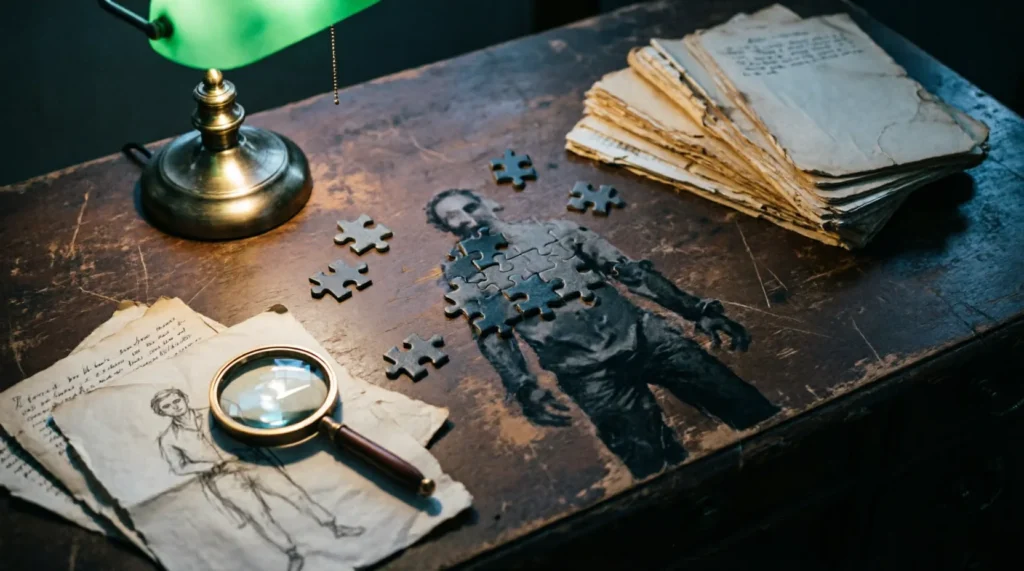
True crime enthusiasts and puzzle solvers know that the best mysteries aren’t just about gore; they are about the chilling logic of deduction. This collection of serial killer riddles with answers for adults is designed specifically for mature audiences who enjoy psychological thrillers, forensic puzzles, and dark lateral thinking challenges without the juvenile fluff.
Top 5 Serial Killer Riddles With Answers for Adults
These five puzzles consistently generate the most debate at my adult game nights because they rely on narrative misdirection rather than simple wordplay. They set the tone for what makes this niche distinct from standard brain teasers.
A woman shoots her husband, then holds him under water for five minutes. Finally, she hangs him. Ten minutes later, they go out together to enjoy a wonderful dinner. How is this possible? Answer: She is a photographer developing film in a darkroom; she “shot” his photo, developed it in liquid chemicals, and hung it up to dry.
A serial killer invites a victim to his home for dinner and offers them two identical glasses of wine. The killer insists the victim choose first. The victim picks a glass, drinks it all, and dies immediately. The killer drinks the other glass and survives. Both glasses contained the exact same poisoned wine. How did the killer survive? Answer: The poison was frozen inside the ice cubes; the killer drank quickly before the ice melted, while the victim sipped slowly, allowing the poison to dissolve into the wine.
A man is found dead in a locked room with no windows, hanging from a high ceiling beam. There is no furniture, ladder, or rope in the room except for a large puddle of water directly beneath his feet. How did he hang himself? Answer: He stood on a block of ice to reach the noose, which eventually melted and left only the puddle.
Two women are arrested for poisoning their husbands with arsenic-laced tea. During interrogation, both confess to putting poison in the teapot, yet only one husband died. Forensics confirm both teapots had lethal doses. Why did one husband survive? Answer: One woman put the poison in the sugar bowl instead of the tea itself, and her husband took his tea unsweetened.
A detective arrives at a crime scene where a wealthy man has been shot. Three suspects were present: the maid, the cook, and the gardener. The maid says she was dusting the library. The cook says she was preparing breakfast. The gardener says he was watering the plants outside. The detective immediately arrests the gardener. Why? Answer: It was raining heavily at the time of the murder, so the gardener could not have been watering plants outside without getting soaked, yet his clothes were completely dry.
Hard Psychological Thriller Riddles
When I test these on true crime podcast listeners, the solve rate drops below thirty percent because they require understanding motive and opportunity over physical evidence. These are genuinely difficult, not just obscure.
A therapist realizes during a session that her patient has murdered someone. The patient never confesses explicitly but describes a dream in perfect detail that matches an unsolved cold case. The therapist cannot report it due to confidentiality, but she solves the case anyway. How? Answer: The patient described hiding the body in a location only the killer would know, and the therapist recognized the geographic details as a place the patient had mentioned avoiding in previous sessions, confirming fabricated memory versus genuine recollection.
A man kills his wife on Valentine’s Day and carefully stages it as a suicide. He writes a note in her handwriting, places the gun in her hand, and locks the house from the inside using a string trick. Police rule it suicide within hours. Years later, a new detective reopens the case and proves murder in five minutes. What was the flaw? Answer: The suicide note referenced a song that wasn’t released until three months after her death.
A serial kidnapper always releases victims unharmed after 48 hours if they can answer one question correctly. Every victim who answered “yes” or “no” was killed. The only survivor gave a different response. What did the survivor say? Answer: The survivor asked a clarifying question back, breaking the binary trap the killer had constructed to justify execution regardless of the answer chosen.
A forensic analyst examines ten crime scenes linked to the same offender. Each scene has a playing card left on the victim. The cards appear random until the analyst notices a pattern that leads to the killer’s arrest. What was the pattern? Answer: The cards spelled out the killer’s name when arranged by date of discovery using the first letter of each card’s suit or rank.
A profiler predicts the next victim of a ritualistic killer will be a left-handed redheaded nurse working the night shift at County General. The prediction is correct, but the profiler admits it wasn’t based on behavioral analysis. What was it based on? Answer: The killer had been leaving clues referencing a specific nursery rhyme, and the next verse matched that exact demographic profile.
A husband reports his wife missing. Police find her diary detailing fears of being stalked. The husband claims ignorance, but detectives charge him within an hour of reading the diary. What gave him away? Answer: The diary entries were written in chronological order but used ink that tested as being from the same pen batch purchased the day after she disappeared, proving he forged it post-mortem.
A killer taunts police by sending letters with cryptic ciphers. After five letters, detectives realize the ciphers aren’t codes at all but something far simpler that reveals the sender’s identity. What were they? Answer: The letters were anagrams of local street names where previous victims were found, indicating the killer lived in that neighborhood.
Tricky Crime Scene Logic Puzzles
These riddles exploit assumptions about how crime scenes work, and in my experience, even law enforcement trainees sometimes fall for the misdirection initially. They reward careful attention to procedural detail.
A body is discovered in a car parked in a garage. The engine is running, the doors are locked from the inside, and there are no signs of forced entry. Carbon monoxide levels are lethal. Yet the medical examiner rules out suicide and accidental death. Why? Answer: The victim was already dead before being placed in the car; rigor mortis indicated time of death preceded the engine start, meaning someone else staged the scene.
A security guard is murdered during his night shift. His flashlight is still on, pointing at the wall, and his radio is keyed open transmitting static. Investigators determine he was attacked from behind despite facing forward. How do they know? Answer: The flashlight beam showed no shadow of the attacker on the wall, meaning the assailant approached from the blind spot directly behind the guard’s head position.
A ransom note demands payment in unmarked bills. The family complies, but the kidnapper returns the money untouched and releases the victim, claiming the wrong person was taken. Police later discover the kidnapper was telling the truth. How did they verify this without DNA? Answer: The victim had a rare blood type incompatible with the ransom drop location’s surveillance footage timestamp, proving the person held was never at the exchange point.
A detective interviews three witnesses to a hit-and-run. All give conflicting descriptions of the car color. Only one witness is deemed credible despite having poor eyesight. Why? Answer: That witness described the sound of the engine and tire tread marks accurately, which matched physical evidence, while others focused on unreliable visual recall under stress.
A locked-room mystery involves a victim stabbed in a study. The window is latched from inside, the door bolted, and the chimney too narrow for passage. Yet the killer escaped. What mundane object provided the exit? Answer: The victim had recently installed a pet door for a cat, which the killer used to reach through and manipulate the latch mechanism from outside.
An alibi hinges on a suspect watching a live broadcast of a sports game at the exact time of the murder. Security cameras show him reacting to plays in real-time. Detectives still break the alibi. How? Answer: The broadcast was delayed by seven seconds in that region, and his reactions aligned with the national feed timing, not the local delay, proving he watched a recording.
A poisoner uses a toxin that mimics natural heart failure. The autopsy shows nothing unusual, but the toxicologist flags the case anyway. What tipped them off? Answer: The victim’s prescription medications included a drug that should have counteracted natural cardiac arrest, making spontaneous failure pharmacologically impossible.
Short & Chilling Quick-Fire Riddles
Perfect for icebreakers at horror-themed parties or pub quiz warm-ups, these deliver maximum unease in minimal words. My groups typically solve half instantly and stare blankly at the rest, creating great pacing variety.
I have cities but no houses, mountains but no trees, and water but no fish. I’ve guided killers to remote graves. What am I? Answer: A map.
I speak without a mouth and hear without ears. I repeated the victim’s last words long after they were gone. What am I? Answer: An echo (or audio recording).
The more you take of me, the more you leave behind. Killers obsess over hiding these. What am I? Answer: Footsteps.
I can be cracked, made, told, and played. Detectives spend careers trying to break me. What am I? Answer: A code (or cipher). According to Riddle, such verbal puzzles have historically served as tests of wit and hidden knowledge across cultures, making them natural vehicles for mystery narratives.
I have keys but no locks, space but no room, and you can enter but never leave. Murderers have typed confessions upon me. What am I? Answer: A keyboard.
I’m always coming but never arrive. Victims dread me; killers promise me. What am I? Answer: Tomorrow.
I can fill a room but take up no space. I vanish when light appears but linger in guilty memories. What am I? Answer: Darkness.
I have a spine but no bones, pages but no paper, and hold secrets that outlive their authors. What am I? Answer: A book (or case file).
I run but never walk, murmur but never talk, have a bed but never sleep. Bodies have been found beside me. What am I? Answer: A river.
I’m owned by everyone but valued by none until lost. Killers steal me; victims beg for me. What am I? Answer: Time.
Dark Humor & Irony Riddles
Not all true crime content needs to be grim; these use gallows humor and ironic twists that resonate with adult audiences familiar with genre tropes. Use sparingly and read the room—these land best with crowds already comfortable with dark comedy.
Why did the serial killer fail his driving test? Answer: He kept making U-turns at dead ends.
What do you call a murderer who only kills people named Dave? Answer: A Dave-id threat.
Why don’t vampires use GPS? Answer: They prefer to follow their instincts—and avoid toll roads.
How does a ghost commit the perfect crime? Answer: By passing through walls and leaving no trace.
What did the cannibal say after eating his roommate? Answer: “I really miss him—he was well-seasoned.”
Why was the detective bad at poker? Answer: He always showed his hand during interrogations.
What’s a zombie’s favorite pickup line? Answer: “You’ve got great brains.”
Why did the werewolf get fired from the butcher shop? Answer: He couldn’t stop moonlighting.
What do you call a psychic who solves crimes? Answer: Medium rare.
Why did the vampire subscribe to the newspaper? Answer: To keep up with current neck-trends.
How to Use These Riddles
Integrating serial killer riddles with answers for adults requires contextual awareness to maintain enjoyment without crossing comfort boundaries. Here are tested approaches from hosting dozens of themed events.
- Pub Quiz Nights: Dedicate one round to “Forensic Logic” using the Hard and Tricky sections. Keep answers visible only to the host, and award bonus points for explaining the reasoning, not just guessing correctly.
- Escape Room Pre-Games: Use Short & Chilling riddles as cipher keys or lock combinations. Their brevity prevents bottlenecking while maintaining atmosphere.
- Book Club Discussions: Pair riddles with true crime readings. Ask members whether the puzzle’s solution mirrors real investigative flaws discussed in the text.
- Road Trip Entertainment: Save Dark Humor riddles for highway stretches where mood-lightening is welcome. Avoid Hard puzzles while driving—they demand focus better reserved for navigation.
- Classroom Critical Thinking: For criminal justice or psychology courses, use Tricky riddles to demonstrate cognitive biases. Have students identify which assumption led them astray before revealing answers.
Frequently Asked Questions
What makes a riddle appropriate for adults versus general audiences? Adult riddles leverage complex vocabulary, cultural references, and thematic maturity that younger solvers lack context for. In this niche, appropriateness means respecting trauma boundaries while engaging sophisticated deductive reasoning—avoiding gratuitous violence in favor of intellectual tension.
How do I handle participants who find true crime themes uncomfortable? Always provide content warnings before starting, offer opt-out options without stigma, and keep alternative non-thematic riddles available. In mixed groups, I’ve found placing darker content in optional bonus rounds preserves inclusivity while satisfying enthusiasts.
Why do some riddles feel unfair even with answers provided? Unfairness stems from missing contextual knowledge the solver couldn’t reasonably possess. Strong riddles embed all necessary clues in the wording itself. If multiple people consistently guess wrong for the same reason, revise the phrasing—the fault lies with the puzzle, not the players. According to Serial, narrative forms thrive on audience engagement through structured revelation, and riddles function similarly by rewarding attentive participation over arbitrary obscurity.
Can these riddles be adapted for team-building in professional settings? Yes, but strip explicit violent references and reframe scenarios around abstract problem-solving. Replace “murder” with “system failure” or “data breach,” keeping the logical structure intact. This maintains cognitive challenge while ensuring workplace appropriateness.

Lisa Thomas combines her background in Education with her passion for brain teasers to bring a unique perspective to RiddleBarn. With 15 years of teaching experience, she believes in the power of puzzles for cognitive development and learning. Her master’s thesis focused on integrating puzzles into educational curriculums to enhance problem-solving skills. Lisa gravitated towards riddles as a way to challenge her students and make learning fun and engaging. At RiddleBarn, she curates content that caters to educators and parents, providing puzzles designed to boost children’s logical thinking and perseverance. Her articles often explore the psychological benefits of puzzling and strategies for incorporating them into daily learning.