

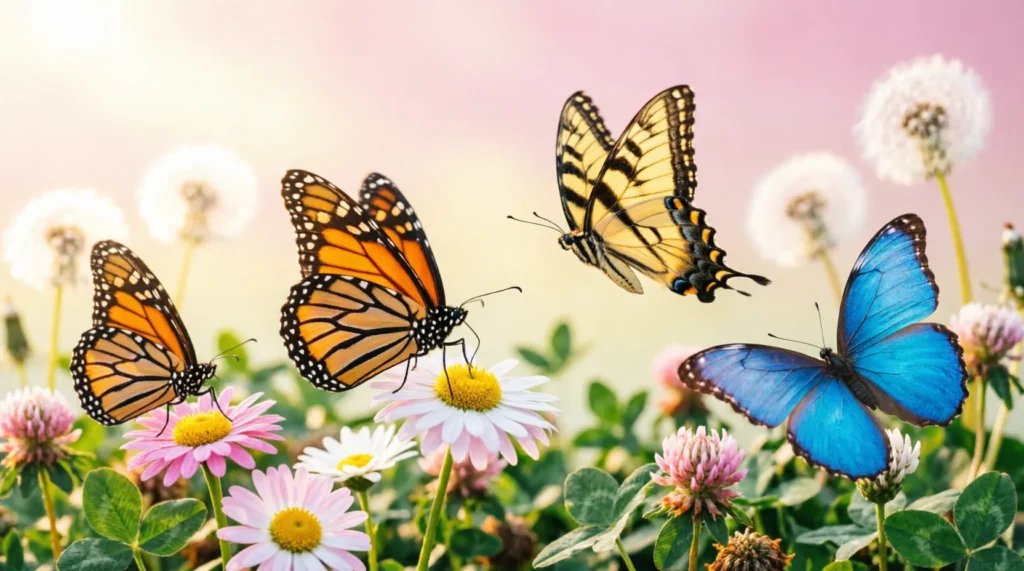
Butterflies are nature’s living stained glass, transforming from humble caterpillars into winged wonders. These butterfly riddles for kids with answers capture that magic in bite-sized puzzles perfect for curious young minds. Whether you’re a teacher planning a spring lesson or a parent looking for screen-free fun, this collection offers the perfect blend of challenge and delight.
Top 5 Butterfly Riddles
These five riddles represent the cream of the crop—the ones that get kids giggling, thinking, and sometimes groaning when they hear the answer. I’ve tested these at family gatherings and classroom parties, and they consistently deliver engagement.
I have wings but cannot fly high like an eagle. I sip nectar but never eat meat. What am I?
Answer: A butterfly
I start as a crawling creature, then wrap myself in a cozy case. When I emerge, I’m completely different. What happened to me?
Answer: Metamorphosis (or I became a butterfly)
I’m colorful and delicate, yet I travel thousands of miles without a map. Birds follow my path every year. What am I?
Answer: A monarch butterfly
You can find me in gardens and meadows, but I’m not a flower. I dance on the breeze and land on petals. What am I?
Answer: A butterfly
I have four wings covered in tiny scales that create brilliant patterns. Scientists study my wings to understand color without paint. What am I?
Answer: A butterfly
Easy Butterfly Riddles for Young Children
These riddles work beautifully for ages 4-7. The language is simple, and the answers are straightforward enough that younger kids can experience the joy of solving them independently. When I read these to my niece’s kindergarten class, even the shyest children raised their hands to guess.
I flutter from flower to flower all day long. What am I?
Answer: A butterfly
I begin life as a small egg on a leaf. What will I become?
Answer: A butterfly
I love to drink sweet nectar from flowers. Who am I?
Answer: A butterfly
I have beautiful wings with many colors. What creature am I?
Answer: A butterfly
I sleep inside a hard shell called a chrysalis. What am I becoming?
Answer: A butterfly
Children often guess “bird” for the first riddle, which makes sense given the flying clue. But butterflies don’t sing, and they don’t have feathers—just those gorgeous scaled wings. According to Wikipedia, butterfly wings are covered in microscopic scales that create their vivid patterns through light refraction rather than pigment alone.
I visit gardens but I’m not a bee. I’m quieter and more graceful. What am I?
Answer: A butterfly
My wings are like paper but much stronger. I float on the wind. What am I?
Answer: A butterfly
I come out when the sun is shining and hide when it rains. What am I?
Answer: A butterfly
Kids love acting out this next one. Have them pretend to be a caterpillar eating leaves, then curl up, then burst open with arms spread wide. It’s kinetic learning at its finest.
I eat leaves all day when I’m young. When I grow up, I drink from flowers. What am I?
Answer: A butterfly
Hard Butterfly Riddles for Older Kids
These riddles require deeper knowledge about butterfly biology and behavior. They’re ideal for ages 8-12 who enjoy a genuine challenge. I’ve noticed that kids who love science facts gravitate toward these—they feel rewarded for paying attention in class.
I am born from an egg smaller than a pinhead. I eat my way through leaves, then disappear into a golden coffin. When I return, I have no mouth for chewing, only a straw for sipping. What transformation did I undergo?
Answer: Complete metamorphosis into a butterfly
This one stumps adults too. The “golden coffin” refers to the chrysalis stage, and the shift from chewing mouthparts to a proboscis is a detail many forget.
I have no voice, yet I communicate through ultraviolet patterns invisible to humans. Birds see me differently than you do. What am I?
Answer: A butterfly
Many kids guess “firefly” here because of the light reference, but butterflies actually reflect UV light through their wing scales to signal mates. It’s a fascinating fact that adds depth to the riddle.
I migrate farther than most birds, traveling up to 3,000 miles across generations. No single butterfly completes the entire journey. What species am I?
Answer: The monarch butterfly
This riddle tests specific knowledge. The multi-generational migration of monarchs is one of nature’s most remarkable phenomena, with great-grandchildren returning to the same trees their ancestors left.
My wings appear blue, but I contain no blue pigment. My color comes from the structure of my scales bending light. What am I?
Answer: A blue morpho butterfly (or simply a butterfly)
Structural coloration is a complex concept, but kids grasp it when you explain it’s like how a soap bubble shows rainbow colors without being painted.
I taste with my feet to find the right plant for my babies. I stand on a leaf to decide if it’s dinner for my caterpillars. What am I?
Answer: A butterfly
This fact always generates surprised reactions. Butterflies have taste receptors on their tarsi (feet), allowing them to identify host plants by landing on them.
Funny Butterfly Riddles That Make Kids Laugh
Humor helps memory stick. These riddles use puns and silly scenarios that get genuine giggles. I use these as icebreakers before diving into harder puzzles—they loosen everyone up.
Why did the butterfly go to school?
Answer: To become a moth-ematician! (Or: To learn about meta-morphosis!)
What do you call a butterfly that tells jokes?
Answer: A laugh-erfly!
Why don’t butterflies play basketball?
Answer: Because they’re afraid of the net!
This one gets groans and laughs simultaneously. The visual of a delicate butterfly tangled in a basketball net is inherently funny to kids.
What’s a butterfly’s favorite type of music?
Answer: Heavy metal… because they love butterflies with iron wings! (Alternative: Jazz, because they like to improvise their flight!)
I prefer the jazz answer—it’s cleaner and encourages kids to think about improvisation.
How does a butterfly send a message?
Answer: By airmail!
What do you call a butterfly wearing a crown?
Answer: A ruler-fly!
Why was the butterfly bad at keeping secrets?
Answer: Because it always spilled the beans… on flowers!
These puns work because they’re accessible. Even younger kids who don’t fully understand wordplay can appreciate the silliness.
Tricky Butterfly Riddles With Unexpected Answers
These riddles deliberately lead solvers down the wrong path. They’re excellent for teaching critical thinking because the obvious answer is usually incorrect. I’ve watched confident kids stumble on these, then light up when they realize the trick.
I have wings but I’m not a bird. I have scales but I’m not a fish. I have a tongue but I don’t speak. What am I?
Answer: A butterfly
The “tongue” refers to the proboscis, which functions like a tongue for drinking. Kids often guess “reptile” because of the scales clue, not realizing butterfly wings have microscopic scales.
I can be found in your garden, but I’m not a plant. I can fly, but I’m not an airplane. I’m beautiful, but I’m not a painting. What am I?
Answer: A butterfly
This riddle uses negation extensively, forcing kids to eliminate possibilities rather than jump to conclusions.
I start with C, end with Y, and have six letters. I’m an insect that loves flowers. What am I?
Answer: Caterpillar (trick question—it’s not a butterfly yet!)
This is my favorite tricky riddle because it subverts expectations. Everyone assumes the answer is “butterfly,” but the spelling clue reveals it’s the larval stage. According to Wikipedia, riddles often rely on misdirection, and this one exemplifies that principle perfectly.
I’m related to moths but I’m more colorful. I rest with my wings up, not flat. What am I?
Answer: A butterfly
The wing position distinction (butterflies fold wings vertically when resting; moths hold them horizontally) is a key identification feature that even many adults don’t know.
Short Butterfly Riddles for Quick Fun
Sometimes you need a rapid-fire round. These one-liners work perfectly for car rides, waiting rooms, or quick brain breaks between activities. Each takes under ten seconds to solve once you know the pattern.
Fluttering flower visitor?
Answer: Butterfly
Caterpillar’s final form?
Answer: Butterfly
Nectar-sipping flyer?
Answer: Butterfly
Winged garden gem?
Answer: Butterfly
Silent color dancer?
Answer: Butterfly
Spring’s flying jewel?
Answer: Butterfly
Leaf-eater turned flyer?
Answer: Butterfly
These work well as warm-ups. I use them to gauge a group’s familiarity with butterflies before moving to harder material.
How to Use These Butterfly Riddles
Riddles are versatile tools. Here’s how I’ve successfully deployed them in various settings:
Classroom Science Lessons: Use the hard riddles as exit tickets. After teaching metamorphosis, ask students to solve the chrysalis riddle. It reinforces vocabulary while feeling like a game.
Birthday Parties: Create a butterfly-themed scavenger hunt. Hide clues around the yard, with each clue being a riddle. The answer leads to the next location. Kids stay engaged for hours.
Road Trips: Take turns reading riddles aloud. The easy ones keep younger siblings involved, while the tricky ones challenge older kids. It beats “I Spy” after the hundredth red car.
Family Game Nights: Divide into teams. Award points for correct answers, with bonus points for explaining why the answer works. This encourages deeper thinking beyond guessing.
Rainy Day Activity: Print these riddles on cardstock, cut them into individual cards, and let kids draw from a jar. They can solve solo or compete against siblings.
Frequently Asked Questions
What age group are these butterfly riddles best for?
These riddles span ages 4-12. The easy section works for preschoolers with adult guidance, while the hard and tricky sections challenge upper elementary students. I’ve found that mixed-age groups work well when you let older kids help younger ones—the teaching reinforces their own understanding.
How do butterfly riddles help with learning?
Riddles build vocabulary, encourage lateral thinking, and reinforce scientific concepts. When kids solve a riddle about metamorphosis, they’re actively recalling the stages rather than passively hearing them. The humor in funny riddles also reduces anxiety around making mistakes, creating a safer learning environment.
Can I use these riddles for commercial purposes?
These riddles are original creations designed for educational and personal use. If you’re creating a published product, I recommend mixing these with your own variations to ensure uniqueness. The core concepts (butterfly biology, metamorphosis) are factual and not copyrightable, but the specific wording of riddles should be treated as creative work.
What if kids can’t solve the harder riddles?
Provide hints rather than answers. For the monarch migration riddle, you might say, “Think about orange and black butterflies.” For the structural color riddle, ask, “Have you ever seen colors on a CD or soap bubble?” Guiding questions maintain engagement without giving away the satisfaction of solving.

Nathan Smith is a seasoned puzzle enthusiast with over 18 years of experience in the field of recreational mathematics and logic puzzles. He holds a degree in Mathematics from the University of Chicago, which has significantly influenced his approach to puzzle creation and analysis. Nathan’s journey into brain teasers began during his college years, where he led the university’s puzzle club and organized annual puzzle hunts. At RiddleBarn, Nathan is dedicated to designing intricate logic puzzles and number riddles that challenge even the most seasoned solvers. His content often features a blend of mathematical insights and playful challenges, aiming to captivate readers who seek depth in their puzzling experiences. Nathan’s expertise lies in breaking down complex ideas into engaging and accessible formats.