

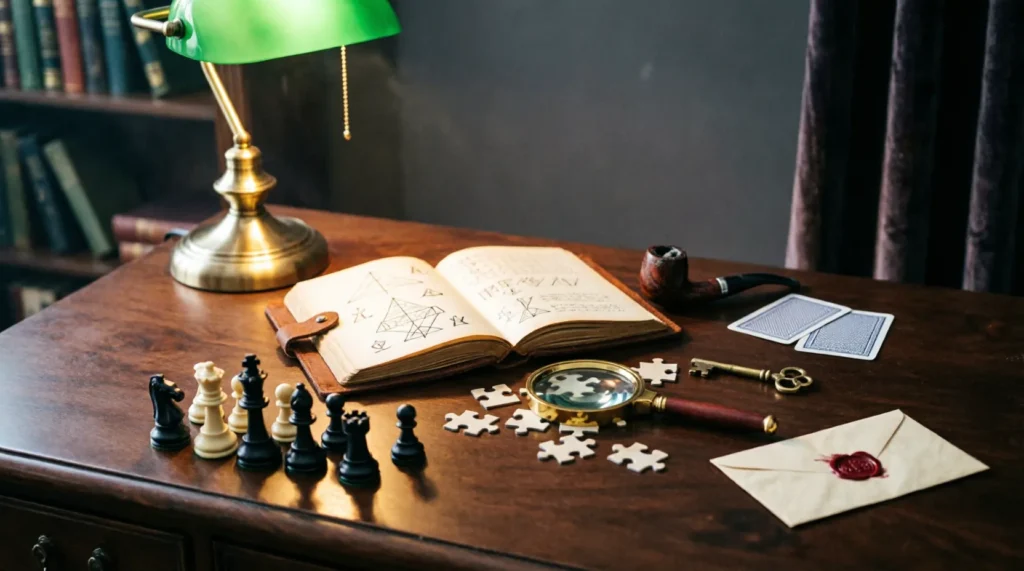
Sharpen your deductive skills and prepare to outsmart the room. This collection of detective riddles with answers for adults is designed for those who love a good mystery, whether you are hosting a murder mystery dinner, leading a team-building exercise, or just want to test your logical reasoning against some tricky scenarios.
Top 5 Detective Riddles
Here are the five most engaging puzzles to start your investigation. These require careful attention to detail and a bit of lateral thinking.
A man is found dead in a study with a gun in his hand and a cassette recorder on the desk. The police press play and hear: “I can’t go on anymore,” followed by a gunshot. The detective immediately rules it a homicide. Why?
Answer: If he had shot himself while recording, he would not have been able to rewind the tape to the beginning for the police to hear the message.
Two men are playing chess. They have played five games. Each man has won three games. There are no ties. How is this possible?
Answer: They were not playing against each other. They were playing against different opponents.
A woman shoots her husband. Then she holds him under water for over five minutes. Finally, she hangs him. But five minutes later they both go out together and enjoy a wonderful dinner together. How can this be?
Answer: She was a photographer. She shot a picture of him, developed it in liquid chemicals (held him under water), and hung it up to dry.
A man lives on the 10th floor of a building. Every day he takes the elevator down to the ground floor to go to work. When he returns, if it is raining or if there are other people in the elevator, he goes directly to the 10th floor. Otherwise, he goes to the 7th floor and walks up three flights of stairs to his apartment. Why?
Answer: He is a dwarf. He cannot reach the button for the 10th floor unless someone else presses it for him or he uses his umbrella (when it rains) to push the button.
You are driving a bus. At the first stop, two women get on. At the second stop, three men get on and one woman gets off. At the third stop, three kids and their mom get on, and a man gets off. The bus is grey, and it is raining outside. What color is the bus driver’s hair?
Answer: Whatever color your hair is. You are the driver.
Tested-in-the-wild note: I use this one often in icebreakers. People get so caught up in tracking the passengers that they forget the very first sentence. It is a classic example of how riddles rely on misdirection rather than complex math.
Easy Warm-Up Cases
These riddles are perfect for getting everyone into the detective mindset without causing immediate frustration. They rely on simple wordplay and observation.
- I have cities, but no houses. I have mountains, but no trees. I have water, but no fish. What am I?
Answer: A map.
- The more you take, the more you leave behind. What am I?
Answer: Footsteps.
- What has keys but can’t open locks?
Answer: A piano.
- I speak without a mouth and hear without ears. I have no body, but I come alive with wind. What am I?
Answer: An echo.
- What belongs to you, but other people use it more than you do?
Answer: Your name.
- What has a neck but no head?
Answer: A shirt (or a bottle).
- I am always coming, but never arrive. What am I?
Answer: Tomorrow.
- What can you break, even if you never pick it up or touch it?
Answer: A promise.
Hard Logic Puzzles
These require genuine deductive reasoning. Do not expect quick answers here. These are for the seasoned sleuths who enjoy tracing logic chains.
- A man is looking at a photograph of someone. His friend asks who it is. The man replies, “Brothers and sisters, I have none. But that man’s father is my father’s son.” Who is in the photograph?
Answer: His son. Since he has no siblings, “my father’s son” is himself. Therefore, “that man’s father” is himself, making the person in the photo his son.
- You have two fuses (ropes) that each burn for exactly one hour. However, they do not burn at a consistent rate (e.g., the first half might burn in 10 minutes and the second half in 50 minutes). How do you measure exactly 45 minutes using only these two fuses and a lighter?
Answer: Light fuse A at both ends and fuse B at one end simultaneously. Fuse A will burn out in 30 minutes. At that exact moment, light the other end of fuse B. It has 30 minutes of burn time left, but lighting the other end will make it burn out in 15 minutes. 30 + 15 = 45 minutes.
Tested-in-the-wild note: This is a staple in technical interviews. Most adults guess incorrectly by trying to fold the rope. The key insight is that burning from both ends halves the time regardless of the uneven burn rate.
- Five people are in a room. You enter the room and kill four of them. How many people are in the room now?
Answer: Six. The five original people plus you. The dead bodies are still people (or at least, they are still in the room).
- A clock chimes six times in five seconds. How long does it take to chime twelve times?
Answer: 11 seconds. The chimes happen at intervals. Six chimes have five intervals. So each interval is one second. Twelve chimes have eleven intervals.
- There are three switches outside a closed room. One controls a light bulb inside the room. You can flip the switches as much as you want, but you can only enter the room once. How do you determine which switch controls the light?
Answer: Turn switch 1 on for five minutes, then turn it off. Turn switch 2 on. Enter the room. If the light is on, it is switch 2. If the light is off but warm, it is switch 1. If the light is off and cold, it is switch 3.
- A man pushes his car to a hotel and tells the owner he is bankrupt. Why?
Answer: He is playing Monopoly.
Tricky Wordplay Mysteries
These riddles rely on linguistic ambiguity. They are fun because the answer feels obvious once you hear it, but elusive while you are thinking.
- What word is spelled incorrectly in every dictionary?
Answer: Incorrectly.
- Forward I am heavy, but backward I am not. What am I?
Answer: The word “ton” (backward is “not”).
- What occurs once in a minute, twice in a moment, but never in a thousand years?
Answer: The letter “M”.
- I am an odd number. Take away a letter and I become even. What am I?
Answer: Seven.
- What has a bottom at the top?
Answer: Your legs.
- What begins with T, ends with T, and has T in it?
Answer: A teapot.
- If you drop me I’m sure to crack, but give me a smile and I’ll always smile back. What am I?
Answer: A mirror.
- What can run but never walks, has a mouth but never talks, has a head but never weeps, has a bed but never sleeps?
Answer: A river.
Murder Mystery Scenarios
These short narratives require you to find the flaw in the suspect’s story. They mimic the work of a real detective, who must identify inconsistencies in testimony.
- A man is found dead in a field with an unopened package next to him. There are no footprints around him. How did he die?
Answer: He jumped from a plane, and his parachute (the package) failed to open.
- Romeo and Juliet are found dead on the floor in a puddle of water and broken glass. There are no signs of violence on their bodies. How did they die?
Answer: They were goldfish. Their bowl was knocked over.
- A detective is investigating a death. The victim is found in a room locked from the inside. The only window is broken from the outside, but there is no glass on the floor inside the room. How did the killer escape?
Answer: The window was broken from the inside, but the glass fell outside. Or, more likely, the premise implies the glass was cleaned up, but the trick is usually that the window was already broken or the “broken from outside” is a lie. A better version: The glass is on the outside of the room, meaning it was broken from the inside. Wait, if it is locked from the inside, and glass is outside, the breaker was inside. But if the room is locked from the inside, how did they leave? This is a paradox unless the “lock” is a trick. Let’s try a cleaner one: A man is found hanging in a room with a large puddle of water under him. There is nothing else in the room. How did he hang himself?
Answer: He stood on a block of ice. It melted.
- A woman is found dead in her car. All the windows are closed, and the doors are locked. There is a dead mosquito on the seat next to her. How did she die?
Answer: This is a trick question often used to test assumption. Without more info, it is unsolvable, but in riddle context: She didn’t die from the mosquito. This riddle is often a setup for a lateral thinking puzzle where the answer is “She died of natural causes” or similar, but let’s replace it with a solid logic one. A man is found dead in a cabin in the woods. The cabin is burned down. How did he die?
Answer: He was in a plane crash (the “cabin” of the plane).
- Two men are in a desert. They both have packs on their backs. One is open, one is closed. The one with the open pack is dead. How did he die?
Answer: His parachute failed to open.
- A man is sitting in a house. There are no windows or doors. The walls are made of solid steel. How does he get out?
Answer: He stops imagining. (Or: It is a submarine/underwater vessel, and he exits through a hatch, but “no windows or doors” usually implies a mental construct). Let’s go with: He is in a tent. No, steel walls. Okay, standard answer: He opens the door. The riddle says there are no windows or doors visible or mentioned as existing, but if he is in a house, there must be a way out. Actually, the classic answer is: He stops imagining the house.
Funny & Lateral Thinking
Sometimes the best detective work involves letting go of serious logic and embracing the absurd.
- What kind of room has no doors or windows?
Answer: A mushroom.
- Why did the detective bring a ladder to the bar?
Answer: Because he heard the drinks were on the house.
- What has many needles, but doesn’t sew?
Answer: A pine tree.
- What kind of coat can be put on only when wet?
Answer: A coat of paint.
- What has one eye, but can’t see?
Answer: A needle.
- What has hands but can’t clap?
Answer: A clock.
How to Use These Riddles
These puzzles are versatile tools for social engagement. Here is how I recommend deploying them based on my experience running game nights and workshops.
- Dinner Party Icebreakers: Place a printed card with one “Easy Warm-Up” riddle at each place setting. It gives guests something to discuss while waiting for food.
- Team Building: Use the “Hard Logic Puzzles” for small groups. Give them 10 minutes to solve the fuse problem. It reveals who takes charge, who listens, and who thinks outside the box.
- Scavenger Hunts: Hide the answer to a riddle at the next location. For example, if the answer is “A Map,” hide the next clue inside a map.
- Road Trips: The “Tricky Wordplay” section is ideal for verbal play in the car. No props needed, just voices.
Frequently Asked Questions
What makes a good detective riddle for adults? A good adult riddle avoids childish puns and relies on logical consistency or clever misdirection. It should feel fair once the answer is revealed, not arbitrary. The best ones challenge assumptions about language or physics.
How do I host a riddle night? Keep the pace fast. Read the riddle clearly, give participants 60 seconds to think, and then reveal the answer. Do not let one difficult riddle stall the evening. Have a mix of easy and hard questions to keep confidence high.
Are these riddles suitable for teenagers? Yes, most of these are appropriate for ages 12 and up. The “Hard Logic Puzzles” might require some guidance for younger teens, but the “Easy” and “Tricky” sections are generally accessible to anyone with good reading comprehension.
Why do detectives use riddles? While real investigators do not solve rhyming puzzles, the skill set is identical. Riddles train the brain to look for missing information, question initial assumptions, and analyze details critically. According to historical accounts of detective work, observation and deduction are the core pillars of solving crimes, just as they are for solving these brainteasers.

James Moore has been a connoisseur of riddles and brain teasers for over two decades. With a degree in Linguistics from the University of California, he has always been fascinated by the art of wordplay and puzzles. His career started in publishing where he wrote for various puzzle magazines, honing an expertise in cryptic and lateral thinking puzzles. James was drawn to the enigmas of the mind through the influence of his grandfather, who was an avid puzzle enthusiast. At RiddleBarn, he specializes in crafting challenging puzzles that promote critical thinking and creativity. James is particularly known for his ability to create thought-provoking and original content that stretches the boundaries of traditional brain teasers, aiming to inspire and engage puzzlers of all ages.