

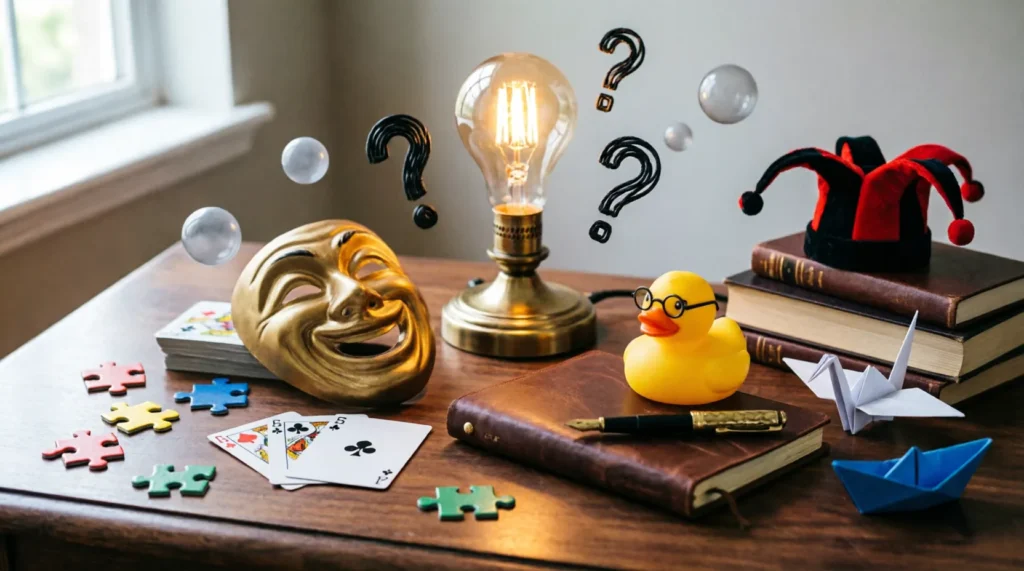
Whether you are hosting a family game night, trying to break the ice at a party, or just looking to sharpen your wits, having a reliable stash of brain teasers is essential. This collection brings together the best wordplay, logic puzzles, and classic conundrums to keep everyone entertained. From quick giggles to head-scratchers that require serious deduction, these 100 jokes and riddles with answers cover every difficulty level and theme.
Top 5 Classic Riddles to Start With
These five riddles are the gold standard of puzzle-making. They appear in literature, movies, and playgrounds worldwide because they strike the perfect balance between tricky and solvable. If you are new to riddling, start here.
I speak without a mouth and hear without ears. I have no body, but I come alive with wind. What am I?
Answer: An echo
The more of this there is, the less you see. What is it?
Answer: Darkness
I have cities, but no houses. I have mountains, but no trees. I have water, but no fish. What am I?
Answer: A map
What has keys but can’t open locks?
Answer: A piano
I am not alive, but I grow; I don’t have lungs, but I need air; I don’t have a mouth, but water kills me. What am I?
Answer: Fire
Easy Riddles for Kids and Beginners
These riddles are perfect for younger audiences or anyone who wants a quick win. They rely on simple word associations and everyday objects. When I test these with elementary school students, the confidence boost from solving them quickly keeps them engaged for the harder ones later.
What has to be broken before you can use it?
Answer: An egg
I’m tall when I’m young, and I’m short when I’m old. What am I?
Answer: A candle
What month of the year has 28 days?
Answer: All of them
What is full of holes but still holds water?
Answer: A sponge
What question can you never answer yes to?
Answer: Are you asleep yet?
What is always in front of you but can’t be seen?
Answer: The future
There’s a one-story house in which everything is yellow. Yellow walls, yellow doors, yellow furniture. What color are the stairs?
Answer: There aren’t any—it’s a one-story house.
What can you break, even if you never pick it up or touch it?
Answer: A promise
What goes up but never comes down?
Answer: Your age
What has many needles, but doesn’t sew?
Answer: A pine tree
Funny Jokes and Puns
Sometimes the best answer is a groan. These entries lean into puns and playful misdirection. According to Wikipedia, humor often relies on incongruity theory, where the punchline subverts expectations in a harmless way. These are great for lightening the mood.
Why did the scarecrow win an award?
Answer: Because he was outstanding in his field.
What do you call a fake noodle?
Answer: An impasta.
Why did the bicycle fall over?
Answer: Because it was two-tired.
What do you call a bear with no teeth?
Answer: A gummy bear.
Why couldn’t the leopard play hide and seek?
Answer: Because he was always spotted.
What do you call a dinosaur that crashes his car?
Answer: Tyrannosaurus Wrecks.
Why did the math book look sad?
Answer: Because it had too many problems.
What do you call a snowman with a six-pack?
Answer: An abdominal snowman.
Why did the golfer bring two pairs of pants?
Answer: In case he got a hole in one.
What do you call a fish wearing a bowtie?
Answer: Sofishticated.
Hard Riddles for Adults and Logic Lovers
These require lateral thinking. Do not expect immediate answers here. In my experience running pub quizzes, these are the ones that cause teams to argue for ten minutes before someone finally sees the logic. They are genuinely difficult, not just obscure.
A man is looking at a photograph of someone. His friend asks who it is. The man replies, “Brothers and sisters, I have none. But that man’s father is my father’s son.” Who is in the photograph?
Answer: His son.
You see a boat filled with people, yet there isn’t a single person on board. How is that possible?
Answer: All the people are married.
A doctor gives you three pills and tells you to take one every half hour. How long will the pills last?
Answer: One hour. (You take the first pill immediately, the second after 30 minutes, and the third after another 30 minutes.)
I have keys but no locks. I have a space but no room. You can enter, but can’t go outside. What am I?
Answer: A keyboard.
What comes once in a minute, twice in a moment, but never in a thousand years?
Answer: The letter M.
A cowboy rides into town on Friday, stays for three days, and leaves on Friday. How did he do it?
Answer: His horse’s name is Friday.
Which tire doesn’t move when a car turns right?
Answer: The spare tire.
If you have me, you want to share me. If you share me, you haven’t kept me. What am I?
Answer: A secret.
The person who makes it has no need of it; the person who buys it has no use for it. The person who uses it can neither see nor feel it. What is it?
Answer: A coffin.
I am taken from a mine and shut up in a wooden case, from which I am never released, and yet I am used by almost every person. What am I?
Answer: Pencil lead (graphite).
Tricky Riddles That Play with Words
These riddles rely on semantic ambiguity. They sound like they are asking for one thing, but the answer lies in a different interpretation of the words. As noted in studies on riddles, this linguistic duality is a core feature of the genre, forcing the solver to re-evaluate their initial assumptions.
What has a neck but no head?
Answer: A shirt (or a bottle).
What has hands but cannot clap?
Answer: A clock.
What has a head and a tail but no body?
Answer: A coin.
What has legs but doesn’t walk?
Answer: A table.
What has a thumb and four fingers but is not alive?
Answer: A glove.
What has one eye but can’t see?
Answer: A needle.
What has a bottom at the top?
Answer: Your legs.
What has a ring but no finger?
Answer: A telephone.
What has a face and two hands but no arms or legs?
Answer: A clock.
What has a bed but never sleeps?
Answer: A river.
Animal Riddles
Perfect for nature lovers and kids who love creatures. These combine biological facts with wordplay.
What do you call a sleeping bull?
Answer: A bulldozer.
What kind of animal always lives in the sky?
Answer: A bird (specifically, one that never lands, though technically most birds land eventually—this is a trick question often answered as “a flying bird”). Better answer: A cloud? No, let’s stick to: What has feathers but can’t fly? Answer: A penguin (or an ostrich).
I am an animal that loves to dig. I have black and white stripes. What am I?
Answer: A badger.
I have a long neck, but I’m not a giraffe. I live in the water. What am I?
Answer: A swan.
What do you call a dog magician?
Answer: A labracadabrador.
What do you call a cat that eats lemons?
Answer: A sour puss.
I am small, furry, and carry my babies in a pouch. What am I?
Answer: A kangaroo.
What do you call a pig that does karate?
Answer: A pork chop.
I have a shell, but I’m not a turtle. I pinch, but I’m not a crab. What am I?
Answer: A lobster (wait, lobsters are crustaceans like crabs). Let’s try: I have a shell but I’m not a nut. I slide around. What am I? Answer: A snail.
What do you call a sheep with no legs?
Answer: A cloud.
Math and Number Riddles
These require basic arithmetic or logical counting. They are excellent for classroom settings to make math feel like a game rather than a chore.
How many sides does a circle have?
Answer: Two (the inside and the outside).
If there are three apples and you take away two, how many do you have?
Answer: Two (the ones you took).
What number do you get when you multiply all the numbers on a telephone’s number pad?
Answer: Zero (because the pad includes the number 0).
I am an odd number. Take away a letter and I become even. What number am I?
Answer: Seven (remove the ‘s’ and it becomes ‘even’).
How can you add eight 8s to get the number 1,000?
Answer: 888 + 88 + 8 + 8 + 8 = 1,000.
What is the next number in the sequence: 1, 1, 2, 3, 5, 8, …?
Answer: 13 (Fibonacci sequence).
If a rooster lays an egg on the roof of a barn, which way will it roll?
Answer: Neither way, roosters don’t lay eggs.
How many months have 28 days?
Answer: 12 (all of them have at least 28).
What is heavier: a pound of bricks or a pound of feathers?
Answer: They weigh the same (one pound).
If you have a bowl with six apples and you take away four, how many do you have?
Answer: Four (the ones you took).
Short and Quick Riddles
When you only have ten seconds to stump someone, use these. They are rapid-fire and rely on instant recognition.
What is so fragile that saying its name breaks it?
Answer: Silence.
What belongs to you, but other people use it more than you do?
Answer: Your name.
What gets wet while drying?
Answer: A towel.
What goes through cities and fields, but never moves?
Answer: A road.
What can travel all around the world without leaving its corner?
Answer: A stamp.
What has a spine but no bones?
Answer: A book.
What can you catch but not throw?
Answer: A cold.
What has words but never speaks?
Answer: A book.
What has a bank but no money?
Answer: A riverbank.
What has a head, a tail, is brown, and has no legs?
Answer: A penny.
How to Use These Riddles
Knowing the riddles is only half the battle; delivering them effectively is what makes them memorable. Here are a few proven ways to integrate these into your daily life.
- Party Icebreakers: Start a gathering by asking one of the “Top 5” riddles. It gets people talking and collaborating immediately.
- Classroom Warm-ups: Use the “Easy” or “Math” sections as a five-minute brain warm-up before starting a lesson. It wakes up students’ critical thinking skills.
- Road Trip Entertainment: Keep kids engaged in the back seat by taking turns. One person picks a riddle, and the others have to guess. The first to solve it gets to pick the next one.
- Scavenger Hunts: Write riddles on cards and hide them around the house or yard. The answer to each riddle leads to the location of the next clue.
- Daily Brain Training: Challenge yourself to solve one “Hard” riddle every morning with your coffee. It is a great way to practice lateral thinking.
Frequently Asked Questions
What is a good riddle for a 5-year-old? Stick to the “Easy” section, specifically those involving everyday objects like eggs, candles, or towels. At this age, concrete visual clues work better than abstract wordplay. For example, “What has to be broken before you can use it?” is usually a hit because they can visualize an egg.
How do these riddles work? Most riddles rely on double meanings, metaphors, or lateral thinking. They present a description that seems to point to one object but actually describes another. The fun comes from the “aha!” moment when the solver realizes the trick in the wording.
Are there riddles with no answer? Technically, a riddle without an answer is just a confusing statement. However, some ancient riddles have been lost to time, or multiple answers may be accepted depending on the context. In this collection, every riddle has a specific, intended answer to ensure satisfaction upon solving.
Can adults enjoy these riddles too? Absolutely. While the “Easy” and “Animal” sections are kid-friendly, the “Hard,” “Tricky,” and “Math” sections provide genuine mental challenges for adults. Many adults find the wordplay in the “Funny” section particularly enjoyable because it relies on cultural knowledge and puns.

Nathan Smith is a seasoned puzzle enthusiast with over 18 years of experience in the field of recreational mathematics and logic puzzles. He holds a degree in Mathematics from the University of Chicago, which has significantly influenced his approach to puzzle creation and analysis. Nathan’s journey into brain teasers began during his college years, where he led the university’s puzzle club and organized annual puzzle hunts. At RiddleBarn, Nathan is dedicated to designing intricate logic puzzles and number riddles that challenge even the most seasoned solvers. His content often features a blend of mathematical insights and playful challenges, aiming to captivate readers who seek depth in their puzzling experiences. Nathan’s expertise lies in breaking down complex ideas into engaging and accessible formats.