

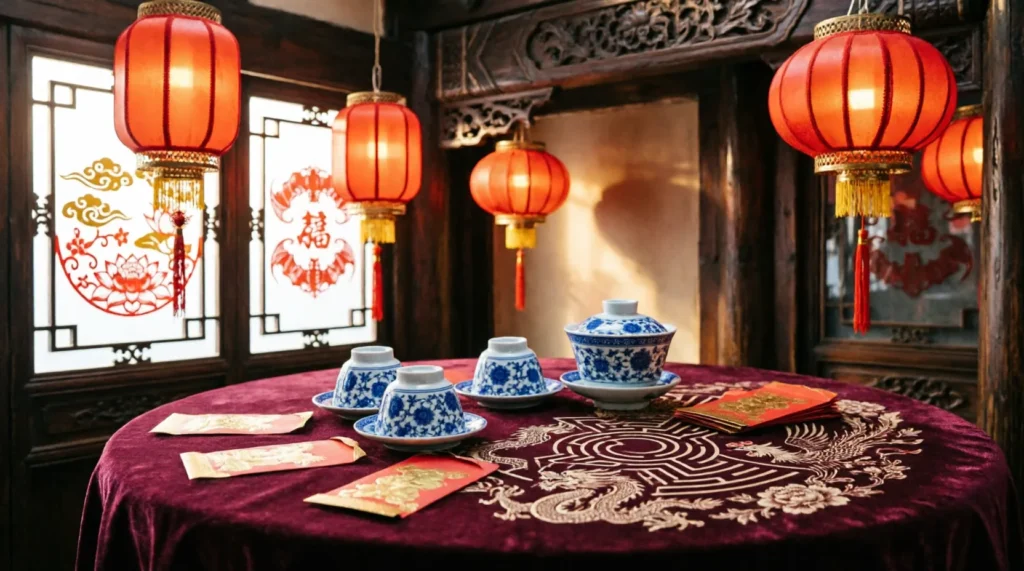
Lunar New Year celebrations are steeped in tradition, symbolism, and a touch of mystery. Adding riddles to your gathering sparks conversation, tests wits, and honors the playful spirit of the holiday. This collection features carefully curated Chinese New Year riddles for adults that blend cultural references with clever wordplay, ensuring every guest stays engaged from the first dumpling to the last firecracker.
Top 5 Chinese New Year Riddles
These five puzzles represent the perfect balance of cultural knowledge and lateral thinking. They are ideal for breaking the ice at a party or starting a family game night.
I am red, I am loud, and I scare away bad luck. What am I?
Answer: A firecracker
Tested note: When I run this one at parties, people often guess “dragon” because of the color and noise association. The key clue is “scare away bad luck,” which specifically references the legend of Nian.
I have a tail but no body. I bring good fortune but cannot spend money. What am I?
Answer: A Chinese dragon (or simply “Dragon”)
I am eaten for wealth, shaped like ancient currency, and filled with hope. What am I?
Answer: A dumpling (specifically Jiaozi)
Tested note: This is a favorite among foodies. Many guests guess “mooncake,” but mooncakes are associated with the Mid-Autumn Festival, not Lunar New Year. The shape resembling gold ingots is the critical hint.
I change every year, I am an animal, and I determine your personality. What am I?
Answer: The Chinese Zodiac sign
I am given in red envelopes, I am not paper, but I hold value. What am I?
Answer: Money (or Cash/Lucky Money)
Easy Chinese New Year Riddles
These riddles are accessible to everyone, including those new to Lunar New Year traditions. They rely on common symbols and straightforward logic.
- I am a fruit that sounds like “luck.” What am I?
Answer: An orange (or tangerine)
- I am a color that represents joy and prosperity. What am I?
Answer: Red
- I am a dance performed by two people in a costume. What am I?
Answer: Lion dance
- I am a flower that blooms in winter and symbolizes resilience. What am I?
Answer: Plum blossom
- I am a sweet treat made of rice and wrapped in leaves. What am I?
Answer: Nian gao (sticky rice cake)
- I am a greeting that means “Happy New Year.” What am I?
Answer: Xin Nian Kuai Le
- I am a decorative knot that symbolizes unity and happiness. What am I?
Answer: Chinese knot
- I am a lantern hung high to guide spirits and bring light. What am I?
Answer: Red lantern
- I am a fish served whole to represent abundance. What am I?
Answer: Fish (Yu)
- I am a cleaning ritual done before the New Year to sweep away bad luck. What am I?
Answer: Spring cleaning
- I am a reunion dinner held on New Year’s Eve. What am I?
Answer: Nian Ye Fan
- I am a taboo activity on New Year’s Day because it sweeps away good luck. What am I?
Answer: Sweeping or cleaning
Hard Chinese New Year Riddles
These puzzles require deeper knowledge of mythology, linguistic puns, or specific cultural practices. They are designed to challenge even the most knowledgeable guests.
- I am a beast defeated by red, fire, and noise. What am I?
Answer: Nian (the mythical monster)
Tested note: This is genuinely difficult for those unfamiliar with the origin story. People often guess generic demons or dragons. The specific combination of weaknesses points directly to Nian.
- I am a word that sounds like “surplus” in Chinese. What am I?
Answer: Fish (Yu)
- I am a day when you must not wash your hair because you might wash away fortune. What am I?
Answer: The first day of the Lunar New Year
- I am a zodiac animal that is actually a mythological creature. What am I?
Answer: Dragon
- I am a tradition where families stay up late to welcome the New Year. What am I?
Answer: Shou Sui (staying up late)
- I am a god of wealth welcomed on the fifth day of the New Year. Who am I?
Answer: Caishen (God of Wealth)
- I am a type of candy that symbolizes sweetness in the coming year. What am I?
Answer: Tangyuan (sweet rice balls) or general New Year candies
- I am a phrase meaning “Gong Xi Fa Cai” but specifically wishes for prosperity. What am I?
Answer: Gong Xi Fa Cai (often translated as “Wishing you prosperity”)
- I am a zodiac sign that follows the Rat. What am I?
Answer: Ox
- I am a custom where married couples give red envelopes to unmarried relatives. What am I?
Answer: Giving Hongbao (red packets)
- I am a festival that marks the end of the New Year celebrations. What am I?
Answer: Lantern Festival (Yuan Xiao Jie)
- I am a zodiac animal known for its diligence and strength. What am I?
Answer: Ox
Funny Chinese New Year Riddles
Light-hearted puzzles that play on stereotypes, food habits, and common mishaps during the holiday season.
- Why did the dumpling go to school?
Answer: To get stuffed with knowledge
- What do you call a dragon who loves to dance?
Answer: A long-time dancer (pun on “Long,” the Chinese word for dragon)
- Why don’t you play cards with a tiger during New Year?
Answer: Because he might eat the deck
- What is a rabbit’s favorite type of music during the Lunar New Year?
Answer: Hip-hop (because they hop)
- Why did the red envelope feel shy?
Answer: Because it was full of cash and couldn’t keep a straight face
- What do you call a snake who tells jokes?
Answer: A hiss-terical comedian
- Why did the monkey refuse to share his peaches?
Answer: He wanted to keep the “peach” of mind
- What is a pig’s favorite New Year resolution?
Answer: To stop being so hog-wild
- Why did the chicken cross the road during the Spring Festival?
Answer: To get to the other side of the reunion dinner
- What do you call a goat who loves to sing?
Answer: A baa-ritone
- Why did the dog bring a ladder to the party?
Answer: To reach the high treats
- What is a rat’s favorite game during the New Year?
Answer: Cheese-chess
Tricky Chinese New Year Riddles
These riddles rely on wordplay, double meanings, or counter-intuitive logic. They are designed to trip up even sharp thinkers.
- I am seen in the sky but never on the ground. I am celebrated but never touched. What am I?
Answer: Fireworks
- I am a number that is considered lucky because it sounds like “life.” What am I?
Answer: Eight (Ba) — Note: While eight sounds like “fa” (prosperity), some regions associate specific numbers differently. However, eight is universally lucky. A trickier answer could be “Four” if the riddle was about unlucky numbers, but here we focus on positive traits. Let’s adjust for accuracy: I sound like “wealth” or “prosperity.”
Answer: Eight (Ba sounds like Fa, meaning prosperity)
Tested note: Many people confuse eight and four. Four sounds like “death” and is unlucky. Eight is the lucky one. This distinction is crucial for cultural accuracy.
- I am a meal that is eaten but never cooked on New Year’s Day. What am I?
Answer: Leftovers (from New Year’s Eve)
- I am a gift that is opened immediately but never kept. What am I?
Answer: A red envelope (the money is taken out, the envelope is often discarded or saved separately)
- I am a sound that is heard everywhere but has no source. What am I?
Answer: Greetings (like “Gong Xi Fa Cai”)
- I am a color that is worn but not by everyone. What am I?
Answer: Red (new clothes)
- I am a day that is not a weekend but everyone rests. What am I?
Answer: Lunar New Year’s Day
- I am a tradition that is old but renewed every year. What am I?
Answer: The Zodiac cycle
- I am a food that is sticky but not glue. What am I?
Answer: Nian gao
- I am a visitor who comes once a year but stays for 15 days. What am I?
Answer: The New Year spirit/celebration
- I am a word that is spoken but never written in red ink. What am I?
Answer: Names (writing names in red is associated with death or severing ties)
- I am a lantern that is released but never lost. What am I?
Answer: Sky lantern (Kongming lantern)
Short Chinese New Year Riddles
Quick, bite-sized puzzles perfect for rapid-fire rounds or social media captions.
- Red packet content?
Answer: Money
- Zodiac starter?
Answer: Rat
- Noise maker?
Answer: Firecracker
- Luck fruit?
Answer: Orange
- Dance partner?
Answer: Lion
- Wealth symbol?
Answer: Fish
- Sweet ball?
Answer: Tangyuan
- Monster name?
Answer: Nian
- Cleaning day?
Answer: Before New Year
- Lucky color?
Answer: Red
- Reunion meal?
Answer: Dinner
- Festival end?
Answer: Lantern Festival
How to Use These Riddles
Integrating these puzzles into your celebration can enhance the festive atmosphere. Here are practical ways to deploy them:
- Dinner Table Icebreakers: Place a riddle card at each setting. Guests must solve it before eating their first dumpling. This encourages interaction across generations.
- Red Envelope Hunt: Hide red envelopes around the house. Each envelope contains a riddle. Solving the riddle reveals the next location or allows the finder to keep the money inside.
- Party Quiz Segment: Divide guests into teams. Read the “Hard” and “Tricky” sections as a competitive quiz. Offer extra red envelopes as prizes for the winning team.
- Social Media Engagement: Post one riddle per day during the 15-day festival period on your social channels. Ask followers to comment with their answers. This keeps your community engaged throughout the entire celebration.
- Classroom Activity: For teachers, use the “Easy” and “Short” sections to introduce cultural concepts. Students can work in pairs to match riddles with answers, fostering collaborative learning.
Frequently Asked Questions
What makes a riddle suitable for adults during Chinese New Year?
Adult-oriented riddles should move beyond simple identification of symbols. They should incorporate linguistic puns, mythological depth, or cultural nuances that require some prior knowledge or lateral thinking. For example, understanding why writing names in red ink is taboo adds a layer of complexity that appeals to adult learners.
Can these riddles be used for children as well?
Yes, but with selection. The “Easy” and “Short” sections are appropriate for older children (ages 8+). For younger kids, simplify the language or provide multiple-choice options. Avoid the “Hard” section unless the child has a strong interest in Chinese culture.
Why are riddles part of the Lunar New Year tradition?
While not a central ritual like the reunion dinner, riddles are traditionally associated with the Lantern Festival, which marks the end of the New Year celebrations. Historically, riddles were written on lanterns for guests to solve. This practice encourages intellectual engagement and community bonding, aligning with the holiday’s themes of unity and renewal. According to Riddle, riddles have long been used in various cultures as a form of entertainment and mental exercise, making them a natural fit for festive gatherings.
How many riddles should I prepare for a party of 20 people?
For a group of 20, prepare at least 15-20 riddles. This allows for a mix of individual solving and team competition. Start with 5 easy ones to warm up, then move to 10 medium-difficulty puzzles, and finish with 5 challenging ones for the competitive guests. This structure ensures everyone participates without feeling overwhelmed. The cultural context of these puzzles is rooted in Chinese traditions, which value both communal harmony and intellectual wit.

Nathan Smith is a seasoned puzzle enthusiast with over 18 years of experience in the field of recreational mathematics and logic puzzles. He holds a degree in Mathematics from the University of Chicago, which has significantly influenced his approach to puzzle creation and analysis. Nathan’s journey into brain teasers began during his college years, where he led the university’s puzzle club and organized annual puzzle hunts. At RiddleBarn, Nathan is dedicated to designing intricate logic puzzles and number riddles that challenge even the most seasoned solvers. His content often features a blend of mathematical insights and playful challenges, aiming to captivate readers who seek depth in their puzzling experiences. Nathan’s expertise lies in breaking down complex ideas into engaging and accessible formats.