

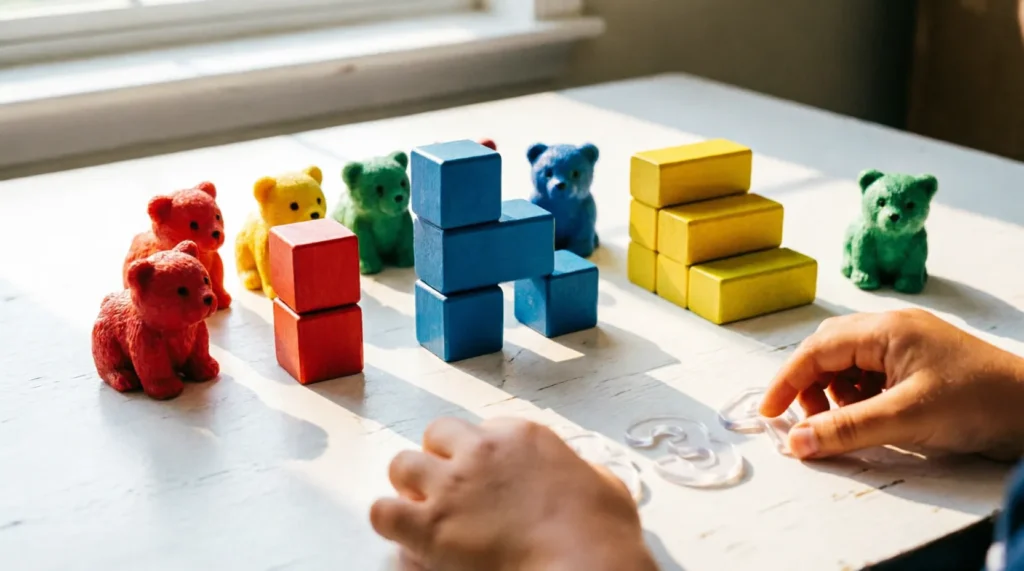
Math doesn’t have to feel like a chore. In fact, when you wrap basic arithmetic in the guise of a mystery or a joke, second graders often lean in with curiosity rather than resistance. This collection is designed specifically for seven and eight-year-olds who are mastering addition, subtraction, and early multiplication concepts. Whether you are a parent looking for a quick brain break during homework time or a teacher needing a warm-up activity, these puzzles turn abstract numbers into tangible, fun challenges.
Top 5 Easy Math Riddles for 2nd Grade
These five riddles are the crowd favorites. They strike the perfect balance between being solvable with basic counting skills and requiring just enough lateral thinking to feel like a real achievement.
I have a face but no eyes, hands but no arms. What am I? Answer: A clock
If you have three apples and you take away two, how many do you have? Answer: Two (because you took them)
What number comes after 19 and before 21? Answer: 20
I am an odd number. Take away one letter and I become even. What number am I? Answer: Seven (remove the ‘s’ and it becomes ‘even’)
How many legs do two dogs and one cat have? Answer: 12 legs (4 + 4 + 4)
Simple Addition and Subtraction Puzzles
These riddles focus on the core curriculum standards for second grade, which typically include fluency with adding and subtracting within 20. They are excellent for reinforcing mental math without the pressure of a worksheet.
If you add 5 to me, you get 12. What number am I? Answer: 7
I am thinking of a number. If you subtract 3 from me, you get 7. What number am I? Answer: 10
There are 10 birds on a fence. 4 fly away. How many are left? Answer: 6
Tom has 8 candies. He gives 3 to his sister. How many does Tom have now? Answer: 5
What is half of 10? Answer: 5
If I have 2 dimes and 1 nickel, how much money do I have? Answer: 25 cents
I am a number between 10 and 15. If you add my digits together, you get 5. What number am I? Answer: 14 (1 + 4 = 5)
Sarah has 6 stickers. Her mom gives her 4 more. How many stickers does she have in total? Answer: 10
What number is 10 less than 30? Answer: 20
If you double 4, what number do you get? Answer: 8
Tester’s Note: When I run the “double 4” riddle with a group of second graders, about half of them instinctively say “16” because they confuse doubling with squaring or just guess a bigger number. It’s a great moment to pause and explain that “double” just means adding the number to itself (4 + 4).
Shape and Geometry Brain Teasers
Second grade is also when students begin to identify and describe shapes. These riddles help them visualize geometric properties without needing a textbook definition.
I have four equal sides and four corners. What shape am I? Answer: A square
I have no corners and no straight sides. I look like a ball. What shape am I? Answer: A sphere (or circle, if discussing 2D)
I have three sides and three corners. What shape am I? Answer: A triangle
I have six faces and all of them are squares. What shape am I? Answer: A cube
I have two long sides and two short sides. I have four corners. What shape am I? Answer: A rectangle
How many sides does a pentagon have? Answer: 5
Tester’s Note: The cube riddle often trips kids up because they think of a “box.” While a box is a cube, the specific geometric term is what we are aiming for. I usually accept “box” as a correct starting point but guide them toward “cube” to build vocabulary.
Time and Money Mysteries
Understanding value and time is a practical skill set for this age group. These riddles contextualize math in everyday scenarios, making the learning stickier.
If today is Monday, what day will it be in 2 days? Answer: Wednesday
How many minutes are in one hour? Answer: 60
If a movie starts at 2:00 and lasts for 2 hours, what time does it end? Answer: 4:00
I have 4 quarters. How much money do I have? Answer: $1.00
Which is worth more: 3 dimes or 1 quarter? Answer: 3 dimes (30 cents vs 25 cents)
If you wake up at 7:00 AM and eat breakfast 30 minutes later, what time is it? Answer: 7:30 AM
How many hours are in a full day? Answer: 24
If a pencil costs 10 cents and you have 50 cents, how many pencils can you buy? Answer: 5
Tester’s Note: The “3 dimes vs 1 quarter” question is a classic trap. Younger children often see the number 3 and assume it’s bigger than 1, ignoring the value of the coins. It’s a fantastic teachable moment for comparing values rather than just counts.
Logic and Pattern Problems
These riddles require a bit more than just calculation; they require spotting a pattern or using logical deduction. This builds critical thinking skills that support advanced math later on.
Look at this pattern: 2, 4, 6, 8. What number comes next? Answer: 10
Look at this pattern: 5, 10, 15, 20. What number comes next? Answer: 25
I am an even number. I am greater than 10 but less than 14. What number am I? Answer: 12
If 2 cats catch 2 mice in 2 minutes, how many cats are needed to catch 100 mice in 100 minutes? Answer: 2 cats (the rate stays the same)
Which number does not belong: 2, 4, 6, 9, 10? Answer: 9 (it is the only odd number)
If you stand in line and you are 5th from the front and 5th from the back, how many people are in line? Answer: 9 people
Tester’s Note: The “line” riddle is surprisingly difficult for adults too! For second graders, I encourage them to draw it out. Drawing circles for people helps them visualize that they are counted twice if they just add 5 + 5.
Funny Number Jokes
Humor lowers anxiety around math. These riddles are less about rigorous calculation and more about wordplay involving numbers. They are perfect for lightening the mood.
Why was 6 afraid of 7? Answer: Because 7, 8, 9 (seven ate nine)
What do you call a number that can’t keep still? Answer: A roamin’ numeral
Why did the student eat his homework? Answer: Because the teacher said it was a piece of cake
What is a snake’s favorite subject? Answer: Hiss-tory (or Math, if they like hiss-teresis, but usually history jokes land better)
Why did the two fours skip lunch? Answer: Because they already 8 (ate)
What do you get when you cross a snowman and a vampire? Answer: Frostbite (not strictly math, but often included in number-themed joke books for winter units)
Tester’s Note: The “7, 8, 9” joke is the most famous math riddle in existence. Even if they’ve heard it, telling it themselves gives them a sense of ownership over the content. It’s a great icebreaker.
How to Use These Riddles
Integrating these puzzles into your routine doesn’t require a lesson plan. Here are a few low-effort, high-reward ways to use them:
- Car Ride Distractions: Instead of screens, try the “Time and Money” section. Ask, “If we leave at 2:00 and drive for 2 hours, when do we arrive?” It keeps their brains active during travel.
- Classroom Warm-Ups: Write one riddle on the board each morning. Let students write their answers on a slip of paper before starting math lessons. It primes their brains for numerical thinking.
- Dinner Table Conversation: Swap the “How was school?” question for a riddle. The “Funny Number Jokes” section works best here to keep the mood light.
- Scavenger Hunt Clues: Hide a treat and leave a riddle as the clue. For example, “I have four equal sides” could lead them to a square box where the next clue is hidden.
According to Wikipedia, riddles have been used throughout history not just for entertainment, but as a method of testing wisdom and intellect. In a modern educational context, they serve as low-stakes assessments of logic and language comprehension.
Frequently Asked Questions
What is a good math riddle for a beginner? Start with visual riddles like “I have four equal sides.” These rely on shape recognition rather than complex arithmetic, building confidence before moving to number-based puzzles.
How do these riddles help with math skills? They encourage mental flexibility. Instead of rote memorization, students must analyze the problem, identify key information, and apply logic. This mirrors the problem-solving steps required in word problems.
Are these riddles suitable for home schooling? Yes. They are particularly effective in home schooling because they can be inserted spontaneously into daily life, reinforcing the idea that math is everywhere, not just in textbooks.
What if my child gets the answer wrong? Celebrate the attempt. Ask them to explain their thinking. Often, the logic behind a wrong answer reveals a specific misconception (like confusing value with count in coin riddles) that you can then address gently.
The concept of Grade in education signifies a stage of development, and second grade is a pivotal time for concrete operational thinking. These riddles are tailored to that specific cognitive stage, ensuring they are neither too babyish nor too abstract.

James Moore has been a connoisseur of riddles and brain teasers for over two decades. With a degree in Linguistics from the University of California, he has always been fascinated by the art of wordplay and puzzles. His career started in publishing where he wrote for various puzzle magazines, honing an expertise in cryptic and lateral thinking puzzles. James was drawn to the enigmas of the mind through the influence of his grandfather, who was an avid puzzle enthusiast. At RiddleBarn, he specializes in crafting challenging puzzles that promote critical thinking and creativity. James is particularly known for his ability to create thought-provoking and original content that stretches the boundaries of traditional brain teasers, aiming to inspire and engage puzzlers of all ages.