

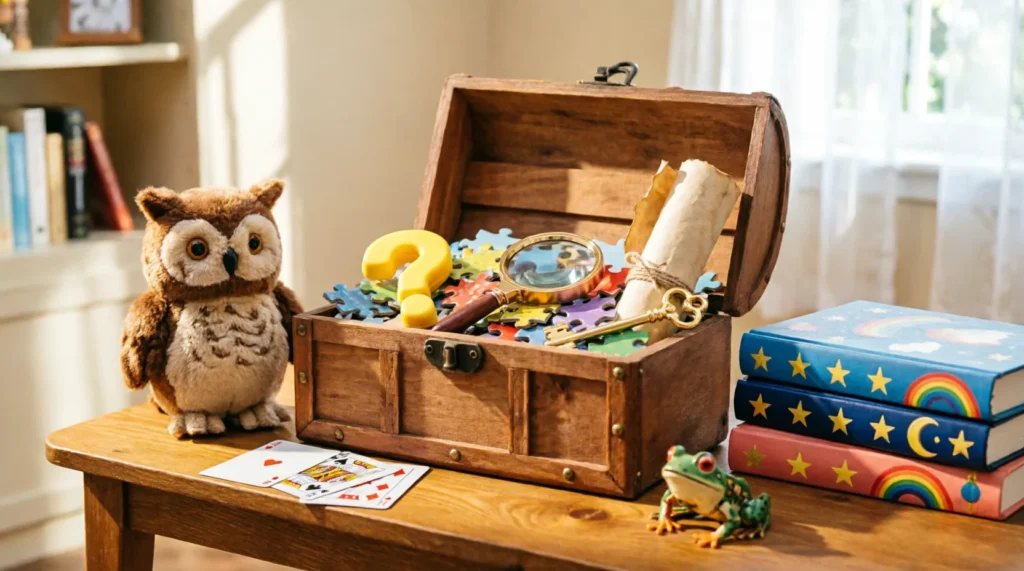
Riddles are one of the oldest forms of wordplay, serving as both entertainment and a mental workout for centuries. According to Wikipedia, riddles have been used in folklore and literature across cultures to test wit, convey wisdom, or simply provoke laughter. For children, they offer a low-stakes way to practice lateral thinking and vocabulary without the pressure of a formal test. This collection gathers the most enduring and popular puzzles, ensuring every child from early readers to pre-teens finds something that challenges and delights them.
Top 5 Famous Riddles for Kids
These five riddles are the classics you will hear at birthday parties, in classrooms, and around dinner tables. They are famous for a reason: the logic is sound, the misdirection is clever, and the “aha!” moment is satisfying.
I have more cities, but no houses. I have more mountains, but no trees. I have water, but no fish. What am I? Answer: A map
What has keys but can’t open locks? Answer: A piano
When I run this one with kids aged 7-9, the wrong guess is almost always “a keyboard.” While modern keyboards do have keys, the classic answer remains the piano because it fits the poetic structure better. It is a great opportunity to discuss homonyms—words that sound the same but mean different things.
What has to be broken before you can use it? Answer: An egg
This is often the first riddle a child learns. It is deceptively simple. The trick here is that children often overthink it, looking for complex mechanical objects. The beauty lies in the everyday nature of the answer.
I’m tall when I’m young, and I’m short when I’m old. What am I? Answer: A candle
What goes up but never comes down? Answer: Your age
This riddle is a favorite because it is personally relevant to every listener. It teaches kids that some concepts are abstract and irreversible. When I use this in group settings, it usually sparks a brief conversation about birthdays and growing up, making it a great icebreaker.
Easy Riddles for Younger Children
These riddles rely on concrete objects and simple logic. They are perfect for ages 4-7 who are just beginning to understand metaphorical language. The answers are things they encounter daily.
What has hands but cannot clap? Answer: A clock
What has one eye but cannot see? Answer: A needle
The visual imagery here is strong. Most children know what a needle looks like, but connecting the “eye” of the needle to the human eye requires a leap in associative thinking.
What gets wet while drying? Answer: A towel
This is a classic paradox riddle. It forces the child to think about the function of an object rather than just its state. It is genuinely easy once explained, but tricky on first hearing.
What has a neck but no head? Answer: A shirt (or a bottle)
Both answers are acceptable, though “shirt” is more common in children’s contexts. This opens up a fun discussion about how we name parts of objects based on their resemblance to body parts.
What belongs to you, but other people use it more than you do? Answer: Your name
This is a profound concept for young minds. It introduces the idea of social identity versus personal ownership. In my experience, kids love this one because it feels like a secret about themselves.
What has legs but cannot walk? Answer: A table
What has many teeth but cannot bite? Answer: A comb
What goes through cities and fields but never moves? Answer: A road
What has a thumb and four fingers but is not alive? Answer: A glove
What begins with T, ends with T, and has T in it? Answer: A teapot
This is a phonetic riddle. It plays on the sound of the letter “T” and the word “tea.” It is excellent for practicing spelling and sound recognition simultaneously.
Funny and Silly Riddles
Humor is a powerful memory aid. These riddles rely on puns, absurdity, or unexpected twists. They are less about deep logic and more about enjoying the playfulness of language.
Why did the scarecrow win an award? Answer: Because he was outstanding in his field!
What do you call a fake noodle? Answer: An impasta
This pun works best if the child knows the word “imposter.” It is a great way to introduce vocabulary in a funny context.
What do you call a bear with no teeth? Answer: A gummy bear
Kids love this one because it connects a scary animal with a candy they enjoy. It subverts expectations effectively.
Why can’t a bicycle stand up by itself? Answer: Because it is two-tired!
What do you call cheese that isn’t yours? Answer: Nacho cheese
This is perhaps the most famous pun riddle for kids. It relies on homophones (“nacho” vs. “not your”). It is silly, memorable, and guarantees a groan-laugh reaction.
What kind of room has no doors or windows? Answer: A mushroom
What do you call a sleeping bull? Answer: A bulldozer
Why did the math book look sad? Answer: Because it had too many problems
This meta-joke works well for school-aged children who can relate to the stress of homework. It personifies an inanimate object in a relatable way.
What has ears but cannot hear? Answer: Corn
This is a double-meaning riddle. “Ears” refers to the part of the corn cob, not auditory organs. It is a gentle introduction to polysemy (words with multiple meanings).
Tricky Riddles That Require Lateral Thinking
These riddles are designed to trap the brain into making an assumption that is incorrect. They require the solver to pause and question their initial impulse. these types of puzzles help inhibit impulsive responses and encourage deeper processing.
The more of this there is, the less you see. What is it? Answer: Darkness
I speak without a mouth and hear without ears. I have no body, but I come alive with wind. What am I? Answer: An echo
This riddle is poetic and requires abstract thinking. It describes a phenomenon rather than an object. I find that older children (10+) appreciate the lyrical quality of this puzzle. For more, see Famous.
What has a head and a tail but no body? Answer: A coin
People often guess “snake” or “worm,” but those creatures have bodies. The trick is to think of objects where “head” and “tail” are terms for sides, not anatomy.
If you drop me I’m sure to crack, but give me a smile and I’ll always smile back. What am I? Answer: A mirror
This riddle combines physical fragility with reflective properties. It is tricky because “smile back” suggests a living thing, but the first line suggests an object.
What can travel all around the world without leaving its corner? Answer: A stamp
This is a classic perspective shift. The stamp stays in the corner of the envelope, but the envelope travels. It teaches kids to consider the context of movement.
What has words but never speaks? Answer: A book
What has a ring but no finger? Answer: A telephone (or a bell)
Modern kids might say “smartphone,” but the traditional answer is a landline telephone. It is a good chance to talk about how technology changes language.
What can you catch but not throw? Answer: A cold
This plays on the multiple meanings of “catch.” It is a humorous twist on physical actions.
Animal Riddles for Nature Lovers
Animals are a perennial favorite topic for children. These riddles describe characteristics, habitats, or behaviors of various creatures.
I have a long neck, but I’m not a giraffe. I carry my house on my back. What am I? Answer: A snail
Wait, snails don’t have long necks. Let’s correct that.
I carry my house on my back. I move slowly and leave a silver trail. What am I? Answer: A snail
I am black and white and loved by everyone. I eat bamboo all day. What am I? Answer: A panda
I have stripes but I am not a tiger. I have hooves but I am not a horse. What am I? Answer: A zebra
I sleep upside down and fly at night. What am I? Answer: A bat
This riddle often scares younger kids, but it is factually accurate. It is a good entry point to discuss nocturnal animals.
I have a trunk but I am not a car. I have large ears but I cannot hear well? No, elephants hear well. Let’s try again.
I have a trunk but I am not a car. I am the largest land animal. What am I? Answer: An elephant
I change my color to blend in with my surroundings. What am I? Answer: A chameleon
This introduces the concept of camouflage. It is a scientific fact wrapped in a riddle.
I live in the ocean and have eight arms. What am I? Answer: An octopus
I buzz around flowers and make honey. What am I? Answer: A bee
This riddle highlights the ecological role of bees. It is simple but educational.
Math and Logic Riddles
These riddles incorporate numbers or logical sequences. They are excellent for reinforcing basic arithmetic skills in a fun context.
If there are three apples and you take away two, how many do you have? Answer: Two
This is a linguistic trap. The question asks how many you have, not how many are left. Most kids answer “one,” forgetting that they are holding the two they took.
How many months have 28 days? Answer: All of them
Every month has at least 28 days. This tests attention to detail rather than calendar memorization.
What number comes next in the sequence: 2, 4, 6, 8, …? Answer: 10
This is a simple even-number sequence. It builds confidence in pattern recognition.
If two’s company and three’s a crowd, what are four and five? Answer: Nine
This is a play on the idiom. It requires listening to the literal mathematical implication rather than the figurative meaning.
I am an odd number. Take away a letter and I become even. What number am I? Answer: Seven
Remove the “s” and you get “even.” This is a word-math hybrid riddle that is very popular in elementary schools.
How many sides does a circle have? Answer: Two (inside and outside)
Or, depending on the level of geometry knowledge, “zero” or “infinite.” For kids, “two” is a clever lateral thinking answer, while “zero” is the strict geometric answer. I prefer accepting both with an explanation.
How to Use These Riddles
Riddles are versatile tools for engagement. Here are a few ways to integrate them into your daily routine:
- Classroom Warm-ups: Start the morning with one riddle on the board. It wakes up brains and encourages participation before lessons begin.
- Road Trip Entertainment: Keep a list handy for long car rides. It reduces screen time and keeps siblings interacting cooperatively.
- Scavenger Hunt Clues: Write riddles on cards and hide them around the house or yard. The answer to each riddle leads to the next clue. For example, if the answer is “fridge,” hide the next clue inside the fridge.
- Bedtime Wind-down: Instead of a story, try a gentle riddle. It shifts the mind from active play to quiet contemplation, aiding sleep transition.
Frequently Asked Questions
What is a good riddle for a 5-year-old? For a 5-year-old, choose riddles with concrete, visible answers like “What has hands but cannot clap?” (A clock). Avoid abstract concepts or complex wordplay. Visual aids can help if they get stuck.
How do these riddles help child development? Riddles enhance vocabulary, promote critical thinking, and improve listening skills. They teach children to look beyond literal meanings and consider multiple perspectives, which is a key component of cognitive flexibility.
Are there riddles that are too hard for kids? Yes. Riddles that rely on obscure historical facts or advanced vocabulary can frustrate young solvers. Stick to topics they know: animals, school items, family, and nature. If a child fails to solve it after two hints, reveal the answer and explain the logic so they learn for next time.
Can I make up my own riddles? Absolutely! Encourage kids to write their own. Start with an object, list its features, and then describe those features without naming the object. It is a creative writing exercise that reinforces descriptive language skills.

Lisa Thomas combines her background in Education with her passion for brain teasers to bring a unique perspective to RiddleBarn. With 15 years of teaching experience, she believes in the power of puzzles for cognitive development and learning. Her master’s thesis focused on integrating puzzles into educational curriculums to enhance problem-solving skills. Lisa gravitated towards riddles as a way to challenge her students and make learning fun and engaging. At RiddleBarn, she curates content that caters to educators and parents, providing puzzles designed to boost children’s logical thinking and perseverance. Her articles often explore the psychological benefits of puzzling and strategies for incorporating them into daily learning.