

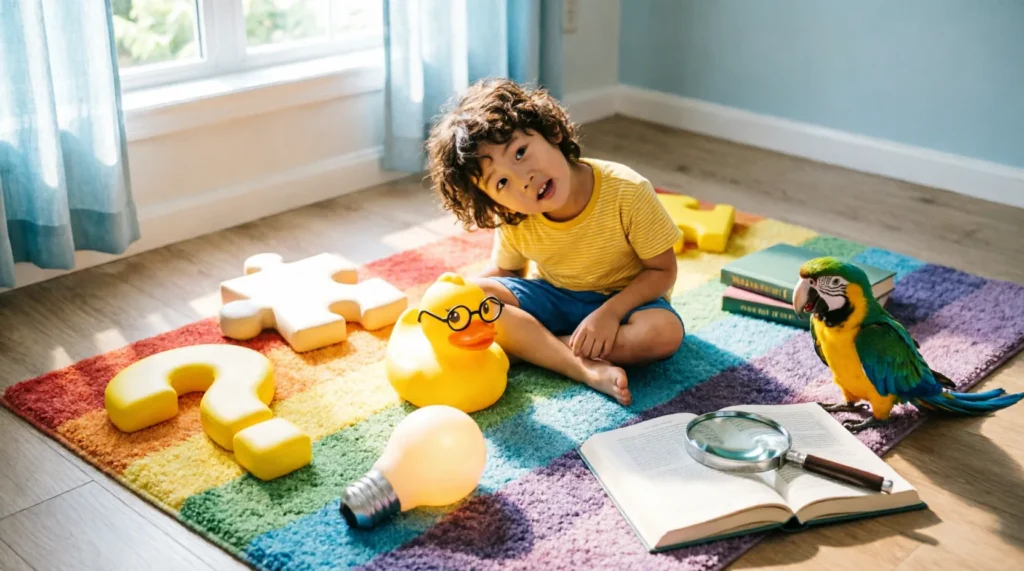
Laughter is the best way to get kids engaged in critical thinking. This collection of funny riddles for kids with answers is designed to spark giggles while sharpening young minds, making it perfect for parents, teachers, and party hosts looking for instant entertainment. Whether you are on a long road trip or hosting a birthday bash, these brain teasers offer a delightful mix of wordplay and logic that children will love to solve.
Top 5 Funny Riddles for Kids
These five riddles are the crowd favorites. They strike the perfect balance between being tricky enough to make kids think and silly enough to make them laugh when they hear the answer.
What has keys but can’t open locks? Answer: A piano
I often use this one as an icebreaker. Kids immediately look for physical keys, so the musical twist catches them off guard every time.
What has hands but cannot clap? Answer: A clock
This is a classic example of personification gone wrong. It forces children to think about objects that have parts named after body parts but lack the biological function.
What goes up but never comes down? Answer: Your age
This riddle usually gets a groan followed by a laugh. It is technically true and impossible to argue with, which makes it a favorite among older elementary students who are just starting to grasp abstract concepts.
What has a head and a tail but no body? Answer: A coin
The visual imagery here is strong, leading kids to imagine animals or monsters. The reveal that it is something they likely have in their pocket right now is always a hit.
What belongs to you, but other people use it more than you do? Answer: Your name
This one requires a bit more social awareness. It is less about physical objects and more about identity, making it a great transition riddle from simple object puzzles to more conceptual thinking.
Easy and Silly Riddles for Younger Kids
For preschoolers and early elementary students, the best riddles rely on simple vocabulary and obvious puns. These are designed to build confidence rather than frustration.
What do you call a bear with no teeth? Answer: A gummy bear
What kind of room has no doors or windows? Answer: A mushroom
What starts with T, ends with T, and has T in it? Answer: A teapot
Why did the cookie go to the doctor? Answer: Because he felt crummy
When I test this with six-year-olds, the punchline “crummy” usually gets the biggest laugh because they understand the double meaning of feeling sick and being a crumbly cookie.
What has many needles but doesn’t sew? Answer: A pine tree
What gets wetter as it dries? Answer: A towel
What has legs but doesn’t walk? Answer: A table
What has one eye but can’t see? Answer: A needle
Why did the banana go to the doctor? Answer: Because it wasn’t peeling well
What is full of holes but still holds water? Answer: A sponge
Tricky Wordplay Riddles
As children grow, they begin to enjoy riddles that play with language structure. These require listening carefully to the specific wording rather than just imagining the object.
- What month of the year has 28 days? Answer: All of them
This is a staple in my classroom activities. Almost every child shouts “February!” before realizing that every single month has at least 28 days. It teaches them to check their assumptions.
What can you catch but not throw? Answer: A cold
What has a neck but no head? Answer: A shirt (or a bottle)
What breaks when you say its name? Answer: Silence
What has words but never speaks? Answer: A book
What runs all around a backyard but never moves? Answer: A fence
What has a bottom at the top? Answer: Your legs
What can travel all around the world without leaving its corner? Answer: A stamp
What has to be broken before you can use it? Answer: An egg
What goes through cities and fields but never moves? Answer: A road
Animal-Themed Funny Riddles
Kids love animals, and combining creature facts with humor creates some of the most memorable riddles. These often involve puns related to animal behaviors or names.
What do you call a sleeping bull? Answer: A bulldozer
Why do fish live in salt water? Answer: Because pepper makes them sneeze
What do you call a dog magician? Answer: A labracadabrador
What do you call a pig that does karate? Answer: A pork chop
Why did the cow cross the road? Answer: To get to the udder side
This variation on the classic chicken joke is always a hit because it relies on a homophone that kids find inherently silly. It is a great example of how Funny humor often relies on unexpected linguistic connections.
What do you call a snake that works for the government? Answer: A civil serpent
Why don’t elephants use computers? Answer: They are afraid of the mouse
What do you call a bear caught in the rain? Answer: A drizzly bear
What kind of bird lifts heavy things? Answer: A crane
What do you call a fast fungus? Answer: A mush-room (zoom room)
Math and Logic Riddles for Smart Kids
These riddles introduce basic mathematical concepts or logical deduction without feeling like homework. They are excellent for developing lateral thinking skills.
- If there are three apples and you take away two, how many do you have? Answer: Two (the ones you took)
This is a trick question that tests reading comprehension as much as math. Most kids answer “one,” forgetting that the question asks how many they have, not how many are left on the table.
How many sides does a circle have? Answer: Two (inside and outside)
What number do you get when you multiply all the numbers on a telephone keypad? Answer: Zero (because of the 0)
If you have a bowl with six apples and you take away four, how many do you have? Answer: Four
What weighs more: a pound of bricks or a pound of feathers? Answer: They weigh the same (one pound)
How can you add eight eights to get one thousand? Answer: 888 + 88 + 8 + 8 + 8 = 1000
What is the next number in the sequence: 1, 1, 2, 3, 5, 8? Answer: 13 (Fibonacci sequence)
If two’s company and three’s a crowd, what are four and five? Answer: Nine
How many months have 28 days? Answer: All 12 months
What is half of two plus two? Answer: Three (Half of two is one, plus two is three)
Short and Quick Fire Riddles
Sometimes you need a riddle that can be asked and answered in under ten seconds. These are perfect for keeping momentum high during games or while waiting in line.
What is black when you buy it, red when you use it, and gray when you throw it away? Answer: Charcoal
What has a thumb and four fingers but is not alive? Answer: A glove
What goes up and down but doesn’t move? Answer: Stairs
What has a spine but no bones? Answer: A book
What has a ring but no finger? Answer: A telephone
What has a face and two hands but no arms or legs? Answer: A clock
What can fill a room but takes up no space? Answer: Light
What disappears as soon as you say its name? Answer: Silence
What has a bank but no money? Answer: A river
What has a head and a tail but no body? Answer: A coin
How to Use These Riddles
Riddles are versatile tools for engagement. Here are a few proven ways to integrate them into your daily routine or special events.
- Dinner Table Conversation: Instead of asking “How was your day?”, start with a riddle. It shifts the mood from interrogative to playful and encourages everyone to participate.
- Classroom Brain Breaks: Teachers can use these as quick mental resets between lessons. The Riddle format has been used for centuries to teach logic and language, making it a timeless educational tool.
- Scavenger Hunt Clues: Write riddles on cards and hide them around the house or yard. Each solved riddle leads to the next clue, with the final answer revealing the location of a treat or prize.
- Road Trip Entertainment: Keep a list of these riddles handy for long car rides. They require no equipment and can keep children entertained for hours without screens.
- Party Icebreakers: At birthday parties, have kids draw riddles from a jar. Those who solve them get a small prize, or they can team up to solve harder ones together.
Frequently Asked Questions
What is a good riddle for a 5-year-old? For five-year-olds, stick to riddles with concrete, visual answers like animals or common household items. “What has a tail and a head but no body?” (A coin) or “What do you call a bear with no teeth?” (A gummy bear) work well because they rely on simple puns or familiar objects.
How do these riddles help children learn? Riddles enhance vocabulary, improve listening skills, and encourage lateral thinking. They teach kids to look beyond the literal meaning of words and consider multiple interpretations, which is a critical component of reading comprehension and problem-solving.
Are there riddles that are too hard for kids? Yes, riddles that rely on obscure historical facts or complex abstract logic can be frustrating. The key is to match the riddle to the child’s developmental stage. If a child cannot solve a riddle after a few hints, provide the answer cheerfully and explain the logic so they learn from it rather than feeling defeated.
Can I use these riddles for commercial purposes? Most traditional riddles are in the public domain and free to use. However, if you are compiling them for a published book or app, it is always good practice to verify the specific wording or any modern variations to ensure you are not infringing on copyrighted collections.

Lisa Thomas combines her background in Education with her passion for brain teasers to bring a unique perspective to RiddleBarn. With 15 years of teaching experience, she believes in the power of puzzles for cognitive development and learning. Her master’s thesis focused on integrating puzzles into educational curriculums to enhance problem-solving skills. Lisa gravitated towards riddles as a way to challenge her students and make learning fun and engaging. At RiddleBarn, she curates content that caters to educators and parents, providing puzzles designed to boost children’s logical thinking and perseverance. Her articles often explore the psychological benefits of puzzling and strategies for incorporating them into daily learning.