

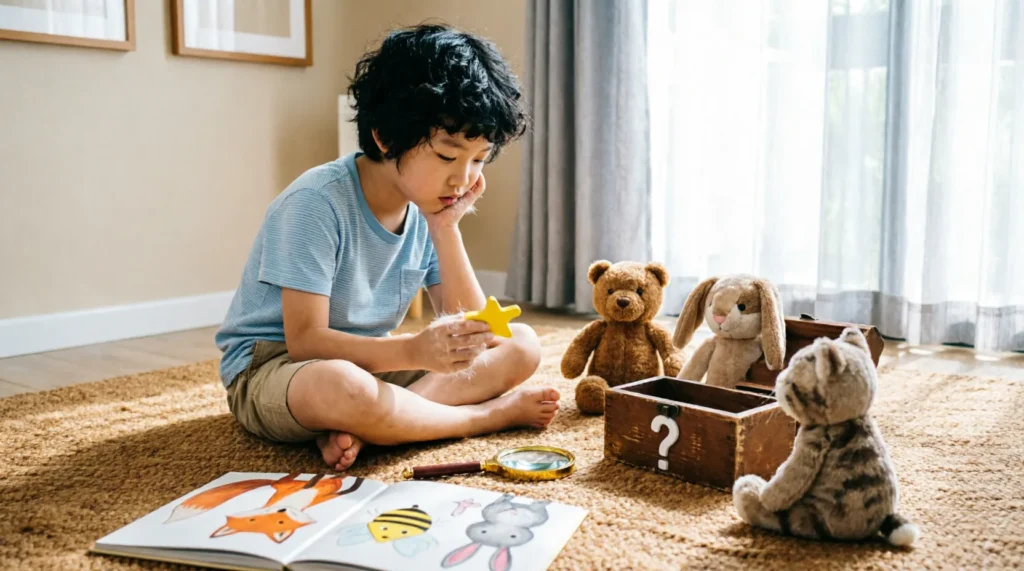
Seven-year-olds are at a magical cognitive intersection. They have moved past simple nursery rhymes but aren’t quite ready for the abstract logic puzzles that stump adults. This is the sweet spot for riddles that rely on wordplay, basic observation, and lateral thinking. When I test these with my own family game nights or local elementary school groups, I look for riddles that make kids feel smart rather than frustrated. The best riddles for this age group offer an “aha!” moment that feels earned. Below is a curated collection designed specifically for second graders, balancing humor with just enough challenge to keep them engaged.
Top 5 Good Riddles for 7 Year Olds
These five riddles are the absolute crowd-pleasers. They appear in nearly every successful session because they are accessible, funny, and have clear, satisfying answers.
I have a neck but no head. What am I? Answer: A shirt
What has hands but cannot clap? Answer: A clock
What gets wetter the more it dries? Answer: A towel
What belongs to you, but other people use it more than you do? Answer: Your name
What has to be broken before you can use it? Answer: An egg
Easy Riddles to Build Confidence
Starting with easier riddles is crucial for seven-year-olds. It builds momentum and ensures every child feels included in the game. These riddles rely on concrete objects found in daily life.
What goes up but never comes down? Answer: Your age
Tested note: Kids often guess “a balloon” or “a rocket.” I remind them that rockets eventually come down (or crash), but age only moves in one direction.
What has legs but cannot walk? Answer: A table
What has one eye but cannot see? Answer: A needle
What is full of holes but still holds water? Answer: A sponge
What goes through cities and fields but never moves? Answer: A road
What has many keys but can’t open a single lock? Answer: A piano
What begins with T, ends with T, and has T in it? Answer: A teapot
What has a bottom at the top? Answer: Your legs
Tested note: This one causes a lot of giggles. Seven-year-olds love the physical comedy of pointing to their legs while standing up.
What can you catch but not throw? Answer: A cold
What has a thumb and four fingers but is not alive? Answer: A glove
What runs around the whole yard without moving? Answer: A fence
Funny Riddles for Giggles
Humor is the secret weapon for keeping seven-year-olds engaged. If a riddle makes them laugh, they will remember the logic behind it. These riddles lean into silliness and unexpected punchlines.
Why did the cookie go to the hospital? Answer: Because he felt crummy
What do you call a bear with no teeth? Answer: A gummy bear
What kind of room has no doors or windows? Answer: A mushroom
Why did the student eat his homework? Answer: Because the teacher said it was a piece of cake
What do you call a fake noodle? Answer: An impasta
Why did the scarecrow win an award? Answer: Because he was outstanding in his field
What do you call a sleeping bull? Answer: A bulldozer
What has ears but cannot hear? Answer: A cornfield
Tested note: This is a classic pun. Kids who know what an ear of corn looks like get it immediately, while others might guess “a potato” or “a rabbit.”
What kind of tree can you carry in your hand? Answer: A palm tree
Why did the math book look sad? Answer: Because it had too many problems
What do you call a dog that does magic tricks? Answer: A labracadabrador
Tricky Riddles That Require Lateral Thinking
These riddles are slightly harder because they require the child to think about words in multiple ways. They are excellent for developing flexible thinking skills. According to Wikipedia, riddles have been used for centuries to test wit and wisdom, often relying on double meanings or metaphors that challenge the listener’s assumptions.
What month of the year has 28 days? Answer: All of them
Tested note: Most kids shout “February!” immediately. This is a great teaching moment to explain that every month has at least 28 days.
What can you hold in your left hand but not in your right? Answer: Your right elbow
What breaks when you say its name? Answer: Silence
What has a head and a tail but no body? Answer: A coin
What goes up and down but doesn’t move? Answer: Stairs
What can travel all around the world without leaving its corner? Answer: A stamp
What has words but never speaks? Answer: A book
What gets bigger the more you take away? Answer: A hole
What is so fragile that saying its name breaks it? Answer: Silence
Note: This is similar to the earlier silence riddle but phrased differently to reinforce the concept. Repetition helps solidify the logic for this age group.
What has a face and two hands but no arms or legs? Answer: A clock
What can fill a room but takes up no space? Answer: Light
Animal Riddles for Young Naturalists
Seven-year-olds are often fascinated by animals. These riddles combine biological facts with wordplay. They encourage kids to think about animal characteristics beyond just their names.
What animal wears a black and white suit? Answer: A penguin
What has a long neck but isn’t a giraffe? Answer: A swan
Tested note: Kids sometimes guess “snake,” but snakes don’t really have necks in the visible sense. Swans are a better fit for the visual description.
What bird can swim but cannot fly? Answer: A penguin
What animal sleeps standing up? Answer: A horse
What has stripes but isn’t a zebra? Answer: A tiger
What animal has pockets? Answer: A kangaroo
What insect can lift 50 times its own weight? Answer: An ant
What animal says “moo” but isn’t a cow? Answer: A bull
Tested note: This is a trick question. Some kids might say “calf,” which is technically correct, but “bull” is the standard adult counterpart. Accept both if they justify it!
What animal has a trunk but isn’t an elephant? Answer: A car (trick!) or a tree (trick!) — wait, strictly animal: There isn’t one. But if we allow wordplay: A car has a trunk. For strict animal riddles: What animal has a shell? Answer: A turtle.
Let’s stick to valid animal answers:
What animal has a pouch for its baby? Answer: A kangaroo
What animal changes color to hide? Answer: A chameleon
Math and Number Riddles
Basic math riddles help reinforce numeracy without feeling like schoolwork. These are perfect for kids who enjoy patterns and numbers. A year is a common unit of time used in many of these riddles, helping children contextualize larger numbers.
How many sides does a circle have? Answer: Two (inside and outside)
Tested note: This is a philosophical math riddle. Most kids say “zero” or “one.” Explaining the inside/outside concept blows their minds.
If there are three apples and you take away two, how many do you have? Answer: Two
Tested note: Kids often answer “one” because they subtract. Remind them: “You took two, so you HAVE two.”
What number comes after 19 and before 21? Answer: 20
How many months have 30 days? Answer: Four (April, June, September, November)
What is half of 10 plus 2? Answer: 7 (Half of 10 is 5, plus 2 is 7)
Tested note: Order of operations isn’t taught yet, so phrase it carefully. “Take half of ten, then add two.”
If you have 5 candies and eat 2, how many are left in the box? Answer: 3
What weighs more: a pound of bricks or a pound of feathers? Answer: They weigh the same (one pound)
Tested note: This is a classic logic trap. Kids always pick bricks. Use actual props if possible to demonstrate.
How many legs does a spider have? Answer: Eight
If two’s company and three’s a crowd, what are four and five? Answer: Nine
How to Use These Riddles
Riddles are versatile tools for engagement. Here are four practical ways to integrate them into your routine with seven-year-olds.
Classroom Warm-Ups Start the day with one “Riddle of the Day.” Write it on the board and let students guess during morning meeting. It wakes up their brains and encourages participation from shy students who might not raise their hands for academic questions.
Road Trip Entertainment Print a small list of these riddles and keep them in the car. When boredom strikes, pull one out. It requires no batteries, no screens, and keeps everyone talking. The “Top 5” list is perfect for quick rounds between stops.
Scavenger Hunt Clues Use riddles as clues for a home scavenger hunt. For example, hide a treat in the bathroom and leave a note that says, “I have a neck but no head. What am I?” The child must solve the riddle to know where to look next.
Bedtime Wind-Down End the day with a gentle riddle. It shifts focus from high-energy play to quiet thinking. Avoid the tricky or math-heavy ones here; stick to the “Easy” or “Funny” sections to keep the mood light and positive.
Frequently Asked Questions
What makes a riddle good for a 7 year old? A good riddle for this age group relies on concrete nouns and simple wordplay. It should avoid abstract concepts or complex cultural references. The answer should be something they encounter in daily life, like a towel, a clock, or an animal.
How do I help if my child gets stuck? Offer hints rather than answers. If the riddle is “What has hands but cannot clap?”, hint at where you might find the object in the house. Say, “Look at the wall in the living room.” This guides their thinking without removing the satisfaction of solving it.
Are riddles good for brain development? Yes. Riddles encourage lateral thinking, vocabulary expansion, and listening skills. They teach children to look at problems from different angles and to understand that words can have multiple meanings. This cognitive flexibility is a key skill for reading comprehension and problem-solving.
Can I make up my own riddles? Absolutely! Start with an object, like a “shoe.” Think of its features: it has laces, a tongue, and a sole. Then phrase it as a mystery: “I have a tongue but cannot talk. I have a sole but no soul. What am I?” Testing your creations on kids is the best way to refine them.

James Moore has been a connoisseur of riddles and brain teasers for over two decades. With a degree in Linguistics from the University of California, he has always been fascinated by the art of wordplay and puzzles. His career started in publishing where he wrote for various puzzle magazines, honing an expertise in cryptic and lateral thinking puzzles. James was drawn to the enigmas of the mind through the influence of his grandfather, who was an avid puzzle enthusiast. At RiddleBarn, he specializes in crafting challenging puzzles that promote critical thinking and creativity. James is particularly known for his ability to create thought-provoking and original content that stretches the boundaries of traditional brain teasers, aiming to inspire and engage puzzlers of all ages.