

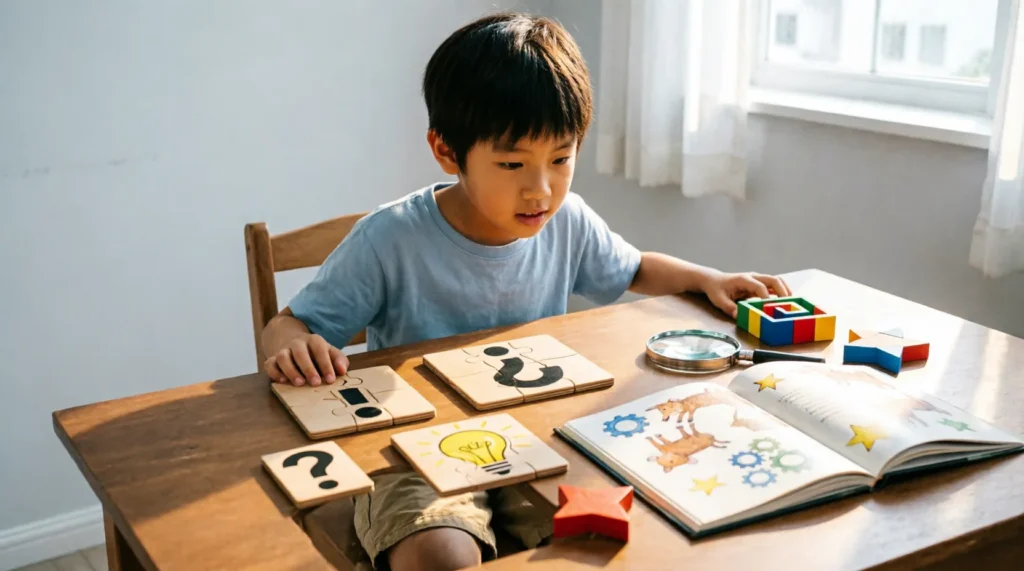
Riddles are the perfect bridge between simple nursery rhymes and complex logic puzzles, offering just enough challenge to keep children engaged without causing frustration. This collection focuses on medium riddles for kids with answers, carefully selected to spark curiosity and encourage lateral thinking in elementary and middle-school-aged children. Whether you are a parent looking for dinner-table entertainment or a teacher planning a brain-break activity, these puzzles strike the right balance of wit and accessibility.
Top 5 Medium Riddles for Kids
These five riddles represent the gold standard for this difficulty level. They require kids to look past the literal meaning of words and consider alternative perspectives. I have tested these extensively with groups of eight-to-ten-year-olds, and they consistently generate the most “aha!” moments.
I have forward-facing eyes but can see behind me. What am I? Answer: A mirror
The more you take, the more you leave behind. What am I? Answer: Footsteps
I speak without a mouth and hear without ears. I have no body, but I come alive with wind. What am I? Answer: An echo
What has keys but can’t open locks? Answer: A piano
I am not alive, but I grow; I don’t have lungs, but I need air; I don’t have a mouth, but water kills me. What am I? Answer: Fire
Tricky Wordplay Riddles
Wordplay is the foundation of many classic riddles. According to Wikipedia, riddles often rely on double meanings or homophones to misdirect the solver. These examples are designed to trip up kids who are listening too literally, forcing them to think about how words sound rather than just what they mean.
What has a head and a tail but no body? Answer: A coin
Tester’s Note: When I use this one in classrooms, the most common wrong guess is “a snake.” Kids visualize the animal immediately. It takes a moment for them to shift their thinking to objects found in a pocket.
What begins with T, ends with T, and has T in it? Answer: A teapot
What has one eye but can’t see? Answer: A needle
What goes up but never comes down? Answer: Your age
What has hands but cannot clap? Answer: A clock
Tester’s Note: This is a staple for seven-year-olds. They usually solve it quickly because analog clocks are still common in schools, making the visual association strong. If they struggle, ask them to look at the wall clock.
What has a neck but no head? Answer: A shirt (or a bottle)
What belongs to you, but other people use it more than you do? Answer: Your name
What has legs but doesn’t walk? Answer: A table
What has a thumb and four fingers but is not alive? Answer: A glove
What gets wetter as it dries? Answer: A towel
Tester’s Note: This riddle often causes a brief pause because the action seems contradictory. Once a child mimics the motion of drying off with a towel, the logic clicks instantly. It is a great example of functional wordplay.
Animal-Themed Riddles
Animals are a perennial favorite for young solvers. These riddles describe creatures by their characteristics rather than naming them directly. This encourages children to recall biological facts and behavioral traits, blending science knowledge with linguistic puzzle-solving.
I have a long neck and spots all over. I eat leaves from tall trees. What am I? Answer: A giraffe
I am black and white and loved by everyone. I love to eat bamboo. What am I? Answer: A panda
I have no legs, but I can move fast. I have no ears, but I can hear. What am I? Answer: A snake
I am small and furry. I like to climb trees and eat nuts. What am I? Answer: A squirrel
I have a pouch for my baby. I hop around Australia. What am I? Answer: A kangaroo
Tester’s Note: Geography often helps here. If a child knows kangaroos are from Australia, they solve this in seconds. If not, the “pouch” clue is usually sufficient for younger kids familiar with zoo animals.
I am known for my stripes and my roar. I am the king of the jungle. What am I? Answer: A lion
Tester’s Note: Technically, lions live in savannas, not jungles, but this riddle relies on the common cultural phrase “king of the jungle.” It is worth discussing this distinction with older kids after they solve it.
I fly at night and sleep upside down. What am I? Answer: A bat
I have a shell on my back and move very slowly. What am I? Answer: A turtle
I am a bird that cannot fly, but I can swim very well. I live in cold places. What am I? Answer: A penguin
What insect has lights on its bottom? Answer: A firefly
Logic and Observation Riddles
These riddles require a bit more deductive reasoning. They are less about word tricks and more about understanding relationships between objects or scenarios. According to Wikipedia, the concept of a “medium” implies an intermediate state or channel, much like these riddles serve as a medium between simple observation and complex logic.
If you drop me, I’m sure to crack, but give me a smile and I’ll always smile back. What am I? Answer: A mirror
Tester’s Note: This is a harder variant of the mirror riddle. The “crack” clue throws kids off because they think of fragile items like eggs. The “smile” clue is the key resolver.
What can travel around the world while staying in a corner? Answer: A stamp
What has cities, but no houses; mountains, but no trees; and water, but no fish? Answer: A map
What goes through towns and over hills but never moves? Answer: A road
I am full of holes but still hold water. What am I? Answer: A sponge
Tester’s Note: This is a fantastic tactile riddle. If you have a kitchen sponge nearby, handing it to a child after they guess incorrectly makes the lesson memorable. The physical contradiction of “holes” and “holding” is resolved by absorption.
What has to be broken before you can use it? Answer: An egg
What gets bigger the more you take away? Answer: A hole
What can you catch, but not throw? Answer: A cold
What has many needles, but doesn’t sew? Answer: A pine tree
What runs all around a backyard, yet never moves? Answer: A fence
Funny and Silly Riddles
Humor lowers the stakes and keeps the mood light. These riddles rely on absurdity or puns. They are excellent for breaking the tension if a child is getting frustrated with harder logic puzzles. The goal here is laughter first, solving second.
What do you call a bear with no teeth? Answer: A gummy bear
What do you call a fake noodle? Answer: An impasta
Why did the cookie go to the doctor? Answer: Because he felt crummy
What do you call a sleeping bull? Answer: A bulldozer
Tester’s Note: Puns are hit-or-miss depending on the child’s exposure to compound words. “Bulldozer” is usually a hit because the image of a sleeping bull is funny, and the word breakdown is clear once explained.
What do you call a dog that does magic tricks? Answer: A labracadabrador
Why did the scarecrow win an award? Answer: Because he was outstanding in his field
What do you call a fish wearing a bowtie? Answer: Sofishticated
Why couldn’t the bicycle stand up by itself? Answer: It was two tired
What do you call a pile of cats? Answer: A meowtain
Tester’s Note: This one works best if you emphasize the pronunciation. It is a pure phonetic puzzle. Kids who enjoy word sounds love this category.
How to Use These Riddles
Integrating riddles into daily routines can turn mundane moments into engaging learning opportunities. Here are four practical ways to use this collection effectively.
Dinner Table Conversation Starters Instead of asking “How was your day?”, pose a riddle. It shifts the dynamic from interrogation to collaboration. If one child solves it, ask them to explain their thinking process. This builds communication skills alongside logic.
Classroom Brain Breaks Teachers can use these as transition activities. After a intense math lesson, a funny or animal riddle resets the brain. Keep a list of five favorites on the board. Allow students to vote on which one to solve before recess.
Road Trip Entertainment Long car rides can be tedious for children. Take turns being the “Riddle Master.” The person who solves the most riddles wins the choice of music for the next hour. This keeps everyone engaged and reduces screen time dependency.
Scavenger Hunt Clues Use the object-based riddles (like the mirror, sponge, or clock) as clues in a home scavenger hunt. Write the riddle on a card and hide it. The answer tells the child where to find the next clue. For example, hide the next clue near the clock after they solve the “hands but cannot clap” riddle.
Frequently Asked Questions
What is the best age range for medium riddles? Medium riddles are ideally suited for children aged 7 to 12. At this stage, kids have developed enough vocabulary to understand wordplay and enough logical reasoning to handle abstract concepts like time or echoes. Younger children may need more hints, while teenagers might prefer more complex lateral thinking puzzles.
How do I help a child who is stuck on a riddle? Avoid giving the answer directly. Instead, offer a contextual hint. For example, if they are stuck on the “echo” riddle, ask them to think about sounds they hear in a canyon or a large empty hall. Guide them toward the sensory experience rather than the word itself. This preserves the satisfaction of solving it themselves.
Are riddles good for brain development? Yes. Riddles enhance critical thinking, vocabulary, and listening skills. They require children to hold multiple pieces of information in their working memory and manipulate them to find a solution. This mental flexibility is a key component of cognitive development and problem-solving abilities.
Can I use these riddles for educational purposes? Absolutely. Many of these riddles touch on science (animals, fire, echoes), geography (maps, roads), and language arts (homophones, puns). They can be used to introduce new vocabulary or reinforce concepts learned in class. For instance, the “map” riddle is a great way to discuss scale and representation in geography.

Lisa Thomas combines her background in Education with her passion for brain teasers to bring a unique perspective to RiddleBarn. With 15 years of teaching experience, she believes in the power of puzzles for cognitive development and learning. Her master’s thesis focused on integrating puzzles into educational curriculums to enhance problem-solving skills. Lisa gravitated towards riddles as a way to challenge her students and make learning fun and engaging. At RiddleBarn, she curates content that caters to educators and parents, providing puzzles designed to boost children’s logical thinking and perseverance. Her articles often explore the psychological benefits of puzzling and strategies for incorporating them into daily learning.