

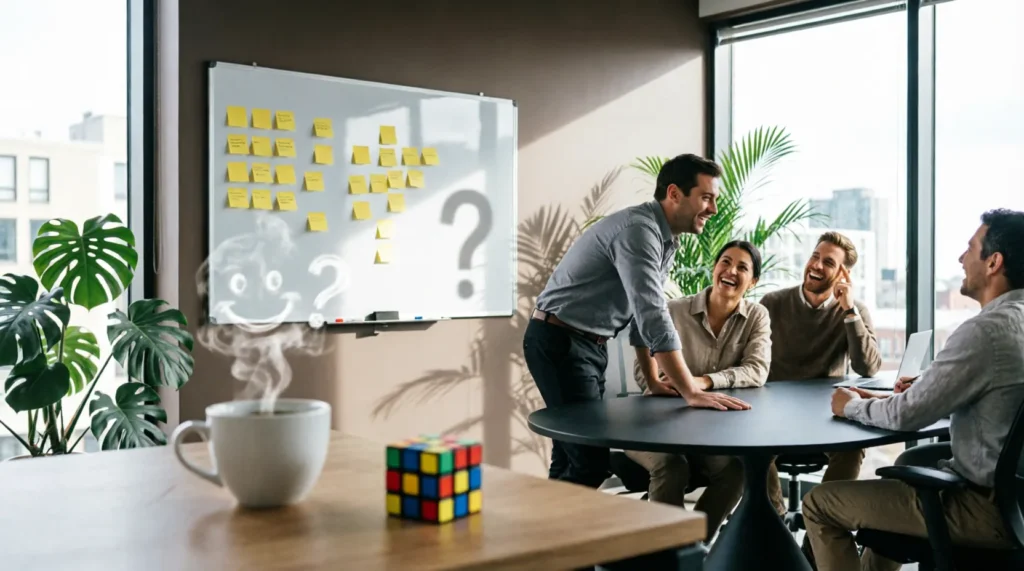
Water cooler conversations can get stale, but a well-timed riddle instantly wakes up the room. Whether you are looking to break the ice at a new job or just need a mental palate cleanser between meetings, this collection delivers the best office jokes and riddles with answers. These puzzles are designed to be safe for work, quick to read, and sharp enough to challenge even the most analytical minds in your department.
Top 5 Office Riddles
These are the cream of the crop—the riddles that have survived the test of time in breakrooms across the globe. They strike the perfect balance between clever wordplay and logical deduction.
I have a spine but no bones. I have pages but no blood. What am I? Answer: A book (or a report binder)
The more you take from me, the bigger I get. What am I? Answer: A hole (or a deficit in the budget)
I speak without a mouth and hear without ears. I have no body, but I come alive with wind. What am I? Answer: An echo (often confused with a phone call in office settings)
What has keys but can’t open locks? Answer: A keyboard
I’m light as a feather, yet the strongest person can’t hold me for much more than a minute. What am I? Answer: Breath
Easy Office Warm-Ups
Start your team building session with these low-stakes puzzles. They are perfect for getting everyone involved without causing frustration. When I use these in introductory workshops, even the shyest interns tend to chime in because the answers feel obvious once revealed.
What goes up but never comes down? Answer: Your age (or the company’s electricity bill)
What has a head and a tail but no body? Answer: A coin
What gets wet while drying? Answer: A towel
What belongs to you but is used more by others? Answer: Your name
What has many needles but doesn’t sew? Answer: A pine tree (or a cactus, though less common in offices)
What has one eye but can’t see? Answer: A needle
What can you catch but not throw? Answer: A cold
What has legs but cannot walk? Answer: A table (specifically, your conference room table)
Funny Office Jokes and Puns
Humor is a critical component of workplace culture. According to Office, the modern workspace is not just a location for productivity but a social hub where interpersonal dynamics play out daily. These riddles lean into the absurdity of corporate life.
Why did the scarecrow win an award? Answer: Because he was outstanding in his field
What do you call a fake noodle? Answer: An impasta
Why did the coffee file a police report? Answer: It got mugged
What do you call a bear with no teeth? Answer: A gummy bear
Why don’t skeletons fight each other? Answer: They don’t have the guts
What do you call a fish wearing a bowtie? Answer: Sofishticated
Why did the bicycle fall over? Answer: Because it was two-tired
What do you call a sleeping bull? Answer: A bulldozer
Tricky Wordplay for Sharp Minds
These riddles rely on linguistic ambiguity. They are designed to trip you up if you read too quickly. I find that engineers and lawyers often excel at these because they are trained to look for loopholes in language. If you rush, you will miss the trick.
A man pushes his car to a hotel and tells the owner he’s bankrupt. Why? Answer: He is playing Monopoly
What occurs once in a minute, twice in a moment, but never in a thousand years? Answer: The letter “M”
Which month has 28 days? Answer: All of them
What can you break without touching it? Answer: A promise (or a record)
What has words but never speaks? Answer: A book
What runs around the whole yard without moving? Answer: A fence
What has a neck but no head? Answer: A shirt (or a bottle)
What is full of holes but still holds water? Answer: A sponge
Hard Logic Puzzles for Senior Staff
Save these for when the team is fully caffeinated. These require lateral thinking rather than just word recognition. In my experience running pub quizzes, these are the ones that cause the most heated debates before the answer is revealed. They separate the guessers from the thinkers.
A man lives on the 10th floor of a building. Every day he takes the elevator down to the ground floor to go to work. When he returns, he takes the elevator to the 7th floor and walks up the stairs to the 10th floor. He hates walking. Why does he do this? Answer: He is short and can only reach the button for the 7th floor
You see a boat filled with people. It has not sunk, but when you look again you don’t see a single person on the boat. Why? Answer: All the people were married
A doctor gives you three pills and tells you to take one every half hour. How long do they last? Answer: One hour (You take the first at 0:00, the second at 0:30, and the third at 1:00)
If you have me, you want to share me. If you share me, you haven’t kept me. What am I? Answer: A secret
What is so fragile that saying its name breaks it? Answer: Silence
The more of this there is, the less you see. What is it? Answer: Darkness
I am not alive, but I grow; I don’t have lungs, but I need air; I don’t have a mouth, but water kills me. What am I? Answer: Fire
A cowboy rides into town on Friday, stays for three days, and leaves on Friday. How is this possible? Answer: His horse’s name is Friday
Short and Snappy Quick-Fire Riddles
Use these for rapid-fire rounds during meetings that are running long. They are designed to be solved in under five seconds. The goal here is speed and momentum. When I facilitate these, I usually set a timer to keep the energy high.
What has a bank but no money? Answer: A riverbank
What has a face and two hands but no arms or legs? Answer: A clock
What goes through cities and fields but never moves? Answer: A road
What has a thumb and four fingers but is not alive? Answer: A glove
What has a bottom at the top? Answer: Your legs
What begins with T, ends with T, and has T in it? Answer: A teapot
What is black when you buy it, red when you use it, and gray when you throw it away? Answer: Charcoal
What has a ring but no finger? Answer: A telephone
Math and Number Riddles for Analysts
For the data-driven members of your team, these puzzles offer a numerical twist. They are less about wordplay and more about basic arithmetic logic. Note that while these involve numbers, they are not complex calculus problems; they are designed to be solvable mentally during a coffee break.
How can you add eight 8s to get the number 1,000 using only addition? Answer: 888 + 88 + 8 + 8 + 8 = 1,000
If two’s company and three’s a crowd, what are four and five? Answer: Nine
I am an odd number. Take away a letter and I become even. What number am I? Answer: Seven (remove the ‘s’ and it becomes ‘even’)
Using only addition, how can you add eight 8s to get 1,000? Answer: 888 + 88 + 8 + 8 + 8 = 1,000
What number do you get when you multiply all of the numbers on a telephone keypad? Answer: Zero (because the keypad includes the number 0)
If you have a cube, each side having a length of 2 inches, what is the total surface area? Answer: 24 square inches (6 sides x 4 square inches per side)
Riddles With a Twist
These riddles subvert expectations. They often sound like standard riddles but have answers that rely on context or lateral thinking that defies the initial setup. The concept of the Riddle has evolved from ancient oral traditions to modern brain teasers, and these examples show how the format continues to adapt to surprise the solver.
What question can you never answer yes to? Answer: “Are you asleep?”
What is always coming but never arrives? Answer: Tomorrow
What can travel around the world while staying in a corner? Answer: A stamp
What has a head, a tail, is brown, and has no legs? Answer: A penny
What goes up and down but doesn’t move? Answer: Stairs
What can fill a room but takes up no space? Answer: Light
What is greater than God, more evil than the devil, the poor have it, the rich need it, and if you eat it you’ll die? Answer: Nothing
How to Use These Riddles
Integrating these puzzles into your workday can boost morale and encourage cross-departmental interaction. Here are four practical ways to deploy them effectively.
- Meeting Icebreakers: Start your weekly stand-up with one “Easy” riddle. It wakes up the brain and creates a shared moment of levity before diving into metrics. Keep it under 30 seconds to maintain momentum.
- Slack/Teams Channels: Create a dedicated channel for daily riddles. Post one “Hard” riddle in the morning and reveal the answer after lunch. This encourages asynchronous engagement and gives remote workers a chance to participate.
- Scavenger Hunts: Hide printed riddles around the office. Each answer leads to the next location. For example, if the answer is “Keyboard,” the next clue is taped under the IT department’s main keyboard supply box. This is excellent for onboarding new hires.
- Road Trip or Commute Challenges: If your team travels together for conferences, use the “Short and Snappy” section for quick verbal games. It passes the time and keeps energy levels up during long drives.
Frequently Asked Questions
What is a good riddle for a professional setting? The best professional riddles are clean, concise, and unrelated to controversial topics. Stick to wordplay or logic puzzles like “What has keys but can’t open locks?” (A keyboard). Avoid riddles that rely on obscure pop culture references or potentially offensive puns.
How do these riddles improve workplace dynamics? Solving riddles together fosters collaborative problem-solving. It allows team members to interact outside of their usual hierarchical roles. When a junior employee solves a tricky logic puzzle that stumps a manager, it builds confidence and mutual respect.
Why are some riddles harder than others? Difficulty depends on the type of thinking required. “Easy” riddles rely on common knowledge. “Hard” riddles require lateral thinking, which means ignoring the obvious interpretation of the words. For example, the riddle about the man taking the elevator to the 7th floor is hard because it requires you to infer physical limitations (height) rather than just processing the words.
Can I use these riddles for virtual teams? Absolutely. Virtual teams benefit even more from structured social interactions. Use the “Funny Office Jokes” section for chat-based humor and the “Logic Puzzles” for video call warm-ups. Ensure you give enough time for typing responses if using text-based platforms.

Nathan Smith is a seasoned puzzle enthusiast with over 18 years of experience in the field of recreational mathematics and logic puzzles. He holds a degree in Mathematics from the University of Chicago, which has significantly influenced his approach to puzzle creation and analysis. Nathan’s journey into brain teasers began during his college years, where he led the university’s puzzle club and organized annual puzzle hunts. At RiddleBarn, Nathan is dedicated to designing intricate logic puzzles and number riddles that challenge even the most seasoned solvers. His content often features a blend of mathematical insights and playful challenges, aiming to captivate readers who seek depth in their puzzling experiences. Nathan’s expertise lies in breaking down complex ideas into engaging and accessible formats.