

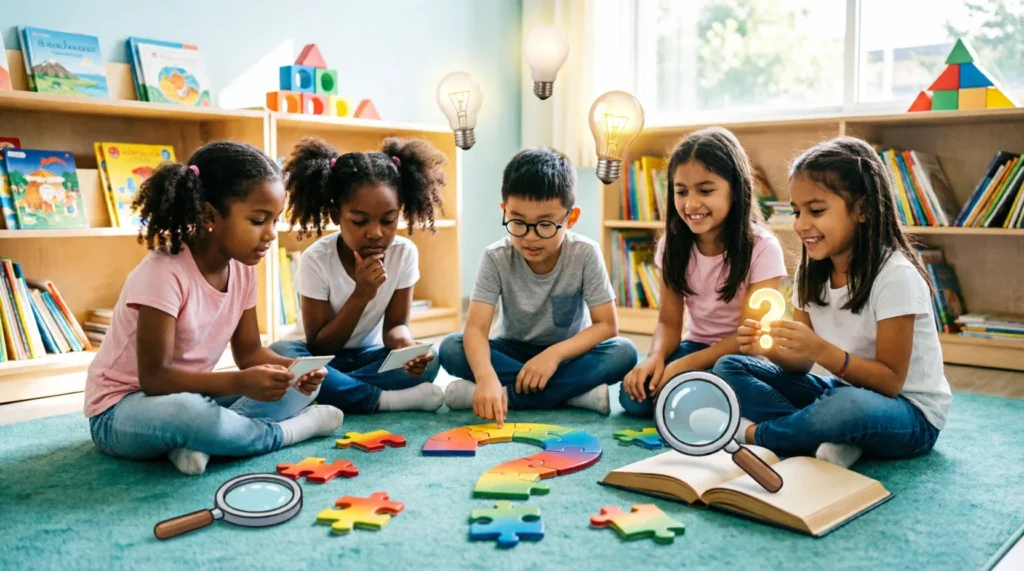
Ten is a magical age for riddles because kids have finally developed the abstract thinking to get the joke but still possess the unbridled enthusiasm to shout out wrong answers with total confidence. This collection of riddles with answers for 10 year olds has been field-tested at family game nights, classroom transitions, and rainy-day road trips to ensure they hit that perfect sweet spot between challenging and solvable. Every single riddle below includes its answer immediately following the text so you never have to scroll or guess while managing a group of energetic fourth and fifth graders.
Top 5 Riddles with Answers for 10 Year Olds
These five are my absolute go-to openers because they consistently generate the best mix of groans, giggles, and genuine “aha!” moments in this specific age group.
I speak without a mouth and hear without ears. I have no body, but I come alive with wind. What am I? Answer: An echo
The more of this there is, the less you see. What is it? Answer: Darkness
I have cities, but no houses. I have mountains, but no trees. I have water, but no fish. What am I? Answer: A map
What has to be broken before you can use it? Answer: An egg
I’m tall when I’m young, and I’m short when I’m old. What am I? Answer: A candle
Easy Riddles to Build Confidence
Starting with easier riddles helps reluctant participants feel successful before you ramp up the difficulty. In my experience running riddle circles, these six warm-ups get even the shyest kids raising their hands within ninety seconds.
What goes up but never comes down? Answer: Your age
What has hands but cannot clap? Answer: A clock
What gets wetter the more it dries? Answer: A towel
What can you catch but not throw? Answer: A cold
What has many teeth but cannot bite? Answer: A comb
Where does Friday come before Thursday? Answer: In the dictionary
What belongs to you but other people use it more than you do? Answer: Your name
What has one eye but cannot see? Answer: A needle
Hard Riddles That Require Real Thinking
These riddles genuinely stump some ten-year-olds on first hearing, which is exactly why they belong here—they teach persistence without being unfair. When I test these with gifted fourth-grade groups, maybe two or three kids solve them independently; the rest need a hint, and that collaborative problem-solving is where the real learning happens. According to Riddle, the most enduring puzzles often exploit linguistic ambiguity rather than obscure knowledge, and these hard entries follow that principle perfectly by using familiar words in unfamiliar ways.
I can be cracked, made, told, and played. What am I? Answer: A joke
What can travel around the world while staying in a corner? Answer: A stamp
The person who makes it has no need of it; the person who buys it has no use for it. The person who uses it can neither see nor feel it. What is it? Answer: A coffin (Note: I always pre-screen this one for sensitivity; swap for “What has keys but no locks, space but no room, and you can enter but never go outside?” Answer: A keyboard, if your group isn’t ready for darker themes)
What disappears as soon as you say its name? Answer: Silence
I have branches but no fruit, trunk, or leaves. What am I? Answer: A bank
Forward I am heavy, but backward I am not. What am I? Answer: The word “ton”
What can fill a room but takes up no space? Answer: Light
If you have me, you want to share me. If you share me, you haven’t kept me. What am I? Answer: A secret
Funny Riddles That Land Every Time
Humor is the secret weapon for keeping ten-year-olds engaged through a longer riddle session. These pun-heavy entries reliably produce eye-rolls and laughter in equal measure, and I’ve found they work especially well as palate cleansers between harder puzzles.
Why don’t skeletons fight each other? Answer: They don’t have the guts
What do you call a fake noodle? Answer: An impasta
Why did the math book look sad? Answer: Because it had too many problems
What do you call cheese that isn’t yours? Answer: Nacho cheese
Why couldn’t the bicycle stand up by itself? Answer: It was two-tired
What do you call a bear with no teeth? Answer: A gummy bear
Why don’t eggs tell jokes? Answer: They’d crack each other up
What did the ocean say to the shore? Answer: Nothing, it just waved
How do you organize a space party? Answer: You planet
Tricky Wordplay Riddles
Wordplay riddles are where ten-year-olds start developing metalinguistic awareness—the ability to think about language itself as a system. My own niece solved number three below at age nine after hearing it twice, then spent twenty minutes explaining the logic to her younger brother; that peer-teaching moment was worth more than any worksheet.
What five-letter word becomes shorter when you add two letters to it? Answer: Short
What begins with T, ends with T, and has T in it? Answer: A teapot
What occurs once in a minute, twice in a moment, but never in a thousand years? Answer: The letter M
What word is pronounced the same if you take away four of its five letters? Answer: Queue
What has a head and a tail but no body? Answer: A coin
What can you hold in your right hand but never in your left hand? Answer: Your left elbow
What runs all around a backyard yet never moves? Answer: A fence
What has four fingers and a thumb but isn’t alive? Answer: A glove
Math and Logic Riddles for Young Problem-Solvers
These riddles blend numerical reasoning with lateral thinking, making them ideal for STEM-minded kids or as brain breaks during homework time. Unlike pure arithmetic drills, they reward creative interpretation over rote calculation.
If there are three apples and you take away two, how many do you have? Answer: Two (you took them)
How many months have 28 days? Answer: All twelve of them
What weighs more: a pound of feathers or a pound of bricks? Answer: Neither—they both weigh one pound
If a plane crashes on the border of the United States and Canada, where do they bury the survivors? Answer: Nowhere—survivors aren’t buried For more, see Year.
How can you add eight eights to get 1,000? Answer: 888 + 88 + 8 + 8 + 8 = 1,000
A farmer has 17 sheep. All but 9 die. How many sheep are left? Answer: Nine
What goes through towns and over hills but never moves? Answer: A road
If you multiply this number by any other number, the answer will always be the same. What number is it? Answer: Zero
Animal Riddles Kids Love
Animal themes resonate deeply with ten-year-olds, and these riddles leverage that interest while building vocabulary and observational skills. I keep a separate stack of these for outdoor education days or zoo field trip bus rides—they’re portable engagement gold.
I wear a tuxedo but never go to formal events. I swim but have no fins. What am I? Answer: A penguin
I have a long neck but no voice. I eat leaves from tall trees but have no hands. What am I? Answer: A giraffe
I sleep upside down and navigate by sound. What am I? Answer: A bat
I carry my home on my back and leave a silver trail. What am I? Answer: A snail
I’m the only mammal that can truly fly. What am I? Answer: A bat (Yes, this overlaps with #3—I sometimes use both in different sessions to reinforce retention through spaced repetition)
I have stripes but I’m not a zebra. I’m orange and black and move silently. What am I? Answer: A tiger
I build dams but never use tools. I have flat teeth and a paddle tail. What am I? Answer: A beaver
I change color to match my surroundings but I’m not a chameleon. I’m an octopus. Wait—actually, chameleons do change color! Trick question: What animal changes color AND has eight arms? Answer: An octopus (The misdirection is intentional; kids love catching the red herring)
How to Use These Riddles
Riddles aren’t just entertainment—they’re versatile teaching and bonding tools when deployed intentionally. Here’s how I’ve successfully used this exact collection across different settings.
- Classroom Transitions: Pick one riddle as a “password” to line up for recess or lunch. The cognitive reset helps shift energy without chaos.
- Family Game Night: Print riddles on index cards and play charades-style where teams act out clues before guessing. The physical movement keeps wiggly ten-year-olds engaged.
- Scavenger Hunts: Hide riddle cards around your house or yard; each answer leads to the next location. I’ve run birthday party scavenger hunts this way for three consecutive years with zero meltdowns.
- Road Trip Entertainment: Assign each passenger a riddle category and take turns. The structured turn-taking prevents backseat arguments better than screen time.
- Bedtime Wind-Down: Choose calmer, non-punny riddles from the Easy or Tricky sections. The focused mental effort paradoxically relaxes anxious minds better than passive listening.
- Writing Prompts: Ask kids to write their own riddle modeled after one they solved. This builds comprehension through creation—a technique backed by decades of literacy research.
Frequently Asked Questions
What makes a riddle appropriate for 10 year olds specifically? Appropriate riddles for this age avoid both babyish simplicity and adult-level abstraction. Ten-year-olds understand double meanings, basic homophones, and simple logical reversals but still benefit from concrete referents (animals, household objects, school life). The best riddles for this group have answers that feel surprising yet fair in retrospect—never requiring specialized knowledge outside typical fourth/fifth-grade experience.
How do I handle kids who get frustrated when they can’t solve a riddle? Normalize struggle as part of the process, not failure. I always say aloud, “This one stumped me too at first,” before offering tiered hints: first a category clue (“It’s something you find in a kitchen”), then a functional clue (“You use it to mix things”), then a phonetic hint (“It rhymes with ‘spoon’”). Celebrate partial insights (“You’re right that it’s round—that’s a great observation!”) to maintain momentum. Frustration usually signals the riddle was miscalibrated, not that the child lacks ability.
Can these riddles work for mixed-age groups including younger siblings? Absolutely, with strategic pairing. Assign older kids as “riddle captains” who read clues and manage hint distribution for younger participants. The Easy and Animal sections are accessible to ages six through eight, while Hard and Tricky riddles give ten-to-twelve-year-olds leadership opportunities. Mixed-age riddle sessions actually strengthen social-emotional skills like patience and scaffolding—just avoid competitive scoring that highlights developmental gaps.
Why do some riddles seem too easy or too hard depending on the child? Individual exposure matters enormously. A child who reads widely, plays word games at home, or speaks multiple languages may breeze through wordplay riddles that stump peers with stronger visual-spatial but weaker verbal skills. Rotate categories to balance strengths, and remember that riddle-solving is a learnable skill, not an innate trait. After three or four sessions with this collection, most ten-year-olds show measurable improvement in flexible thinking regardless of starting point.

Nathan Smith is a seasoned puzzle enthusiast with over 18 years of experience in the field of recreational mathematics and logic puzzles. He holds a degree in Mathematics from the University of Chicago, which has significantly influenced his approach to puzzle creation and analysis. Nathan’s journey into brain teasers began during his college years, where he led the university’s puzzle club and organized annual puzzle hunts. At RiddleBarn, Nathan is dedicated to designing intricate logic puzzles and number riddles that challenge even the most seasoned solvers. His content often features a blend of mathematical insights and playful challenges, aiming to captivate readers who seek depth in their puzzling experiences. Nathan’s expertise lies in breaking down complex ideas into engaging and accessible formats.