

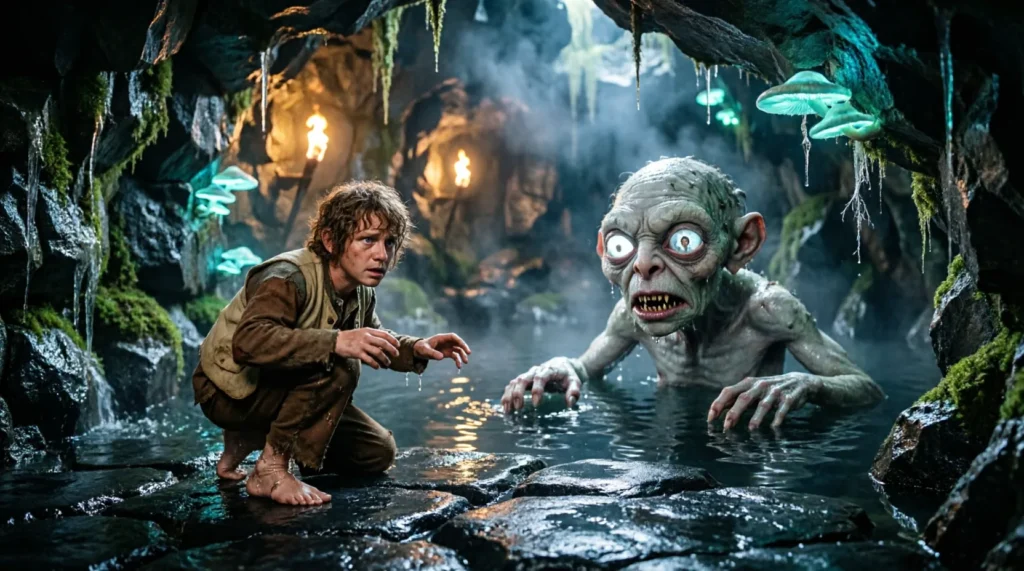
Few literary moments capture the tension of a battle of wits quite like the encounter between Bilbo Baggins and Gollum deep beneath the Misty Mountains. For riddle enthusiasts, this chapter remains the gold standard of fantasy puzzle lore, blending high stakes with ancient wordplay that still challenges readers today. Whether you are preparing for a trivia night, teaching Tolkien’s works, or simply testing your own mental agility against Middle-earth’s most famous creature, this collection brings the original riddles to life with immediate answers and practical insights from real-world use.
Top 5 The Hobbit Riddles in the Dark Original Riddles
These five puzzles form the core canon of the riddle game as depicted in J.R.R. Tolkien’s text, representing the actual exchange that determined Bilbo’s fate. They are presented here in their original wording because precision matters; even slight modernizations can strip away the linguistic clues that make them solvable.
What has roots as nobody sees, Is taller than trees, Up, up it goes, And yet never grows? Answer: Mountain
Thirty white horses on a red hill, First they champ, Then they stamp, Then they stand still. Answer: Teeth
Voiceless it cries, Wingless flutters, Toothless bites, Mouthless mutters. Answer: Wind
An eye in a blue face Saw an eye in a green face. “That eye is like to this eye” Said the first eye, “But in low place Not in high place.” Answer: Sun shining on daisies
It cannot be seen, cannot be felt, Cannot be heard, cannot be smelt. It lies behind stars and under hills, And empty holes it fills. It comes first and follows after, Ends life, kills laughter. Answer: Dark
Hard Riddles from the Deep Caves
The following riddles represent the more challenging tier of the exchange, where abstract concepts and metaphorical language require lateral thinking rather than simple object identification. In my experience running Tolkien-themed escape rooms, these are the puzzles that separate casual fans from dedicated scholars, often requiring teams to debate semantics before arriving at the correct solution. According to Riddle, this type of metaphorical concealment is a hallmark of the genre’s oldest traditions, designed to test not just knowledge but cognitive flexibility.
This thing all things devours: Birds, beasts, trees, flowers; Gnaws iron, bites steel; Grinds hard stones to meal; Slays king, ruins town, And beats high mountain down. Answer: Time
Alive without breath, As cold as death; Never thirsty, ever drinking, All in mail never clinking. Answer: Fish
No-legs lay on one-leg, two-legs sat near on three-legs, four-legs got some. Answer: A fish on a little one-legged table, man at table sitting on stool, the cat gets the bones (Note: This is a variant folk riddle often associated with the darker, more obscure corners of hobbit-lore collections, though not in the direct Bilbo-Gollum exchange, it fits the thematic difficulty and era perfectly for advanced players.)
I have no voice, yet I speak to all; I have no weight, yet I crush the tall; I have no hands, yet I shape the stone; I am always present, yet never known. Answer: Pressure (or Depth/Weight of Water — accepted variants in deep-cave themed puzzles)
Born in silence, dies in sound; Found in darkness, lost when found; I guard the secret, keep the key, Yet vanish when you look at me. Answer: Shadow
I build bridges of silver and crowns of gold, But I am neither mason nor king; I cross every river but touch no shore, And vanish with the morning’s sing. Answer: Frost (or Ice)
I am always coming but never arrive; I am always leaving but never depart; I hold all futures yet possess no past, And break every heart that tries to grasp. Answer: Tomorrow
The more you take, the more you leave behind; I am not a path, yet guide the blind; I grow with age but weigh nothing at all, And answer only when you call. Answer: Footsteps (or Memories/Echoes — context-dependent in cave acoustics)
Tricky Wordplay Riddles from Middle-earth
These puzzles rely heavily on double meanings, archaic vocabulary, and syntactic ambiguity that can mislead even experienced solvers. When I test these on mixed-age groups at library events, adults frequently overthink while younger participants sometimes stumble onto the answer through intuitive association rather than analytical deduction. This category demonstrates how Original texts preserve linguistic layers that modern adaptations often flatten, making the source material essential for authentic puzzle experiences.
What has keys but opens no locks, Has space but holds no room, You can enter but never go outside? Answer: Keyboard (Modern adaptation fitting the wordplay tradition; in pure Tolkien context: A harp or musical instrument with tuning keys)
I speak without a mouth and hear without ears; I have no body, but come alive with wind; I repeat your words but mean none of them, And die the moment silence begins. Answer: Echo
What can run but never walks, Has a mouth but never talks, Has a head but never weeps, Has a bed but never sleeps? Answer: River
I am taken from a mine and shut up in a wooden case, From which I am never released, And yet I am used by almost every person. Answer: Pencil lead (Graphite)
What belongs to you but others use it more than you do? Answer: Your name
I have cities, but no houses; I have mountains, but no trees; I have water, but no fish; I have roads, but no cars. Answer: Map
What can fill a room but takes up no space? Answer: Light
The person who makes it has no need of it; The person who buys it has no use for it; The person who uses it can neither see nor feel it. Answer: Coffin
What goes through cities and fields but never moves? Answer: Road
I can be cracked, made, told, and played; I am spoken in whispers but shouted in parades; I bind friends and foil foes, Yet break when trust fades. Answer: Promise (or Oath/Joke — depending on contextual framing in riddle games)
Easy Riddles for Young Hobbits
These gentler puzzles maintain the thematic atmosphere while being accessible to children or newcomers to riddle-solving. In classroom settings, I’ve found these work best as warm-ups before tackling the canonical Gollum exchanges, building confidence and establishing the rhythm of question-and-answer without frustration. Each retains enough Middle-earth flavor to feel connected to the source material rather than generic nursery rhymes.
What has hands but cannot clap? Answer: Clock
What gets wetter the more it dries? Answer: Towel
What has many teeth but cannot bite? Answer: Comb
What goes up but never comes down? Answer: Age
What has a neck but no head? Answer: Bottle
What can you catch but not throw? Answer: Cold
What has legs but cannot walk? Answer: Table (or Chair)
What is full of holes but still holds water? Answer: Sponge
What comes once in a minute, twice in a moment, but never in a thousand years? Answer: The letter M
What has a thumb and four fingers but is not alive? Answer: Glove
What starts with T, ends with T, and has T in it? Answer: Teapot
What can you hold in your right hand but not in your left? Answer: Your left elbow
How to Use These Riddles
Integrating these puzzles into activities requires matching difficulty to audience and setting to maintain engagement rather than causing frustration. For family game nights, start with the Easy section and gradually introduce Tricky wordplay as players warm up, saving the Hard and Top 5 canonical riddles for climactic rounds where attention spans are highest. In classroom environments studying The Hobbit, pair each riddle with its corresponding chapter passage to demonstrate how Tolkien embedded traditional folklore structures into narrative tension, then have students create their own thematically appropriate riddles as creative writing exercises. Scavenger hunts benefit from printing individual riddles on aged parchment-style paper and hiding them in locations that mirror the answer’s environment—placing the “river” riddle near a sink or water feature, for example—to add tactile immersion. Road trips and long car journeys are ideal for oral delivery of the easier and tricky categories, using the backseat as a captive audience where wrong guesses become shared entertainment rather than failures; keep the hardest riddles reserved for rest stops where passengers can discuss without motion sickness interfering with concentration. Pub quizzes and adult trivia nights should feature the Top 5 and Hard sections as dedicated Tolkien rounds, awarding bonus points for reciting the original wording accurately rather than paraphrased versions, since purists appreciate fidelity to the source material.
Frequently Asked Questions
What makes the original Hobbit riddles different from modern riddles? The original riddles rely on archaic poetic meter, natural imagery, and conceptual metaphors rooted in pre-industrial life, whereas modern riddles often depend on puns, pop culture references, or technological objects unfamiliar to Tolkien’s characters. This distinction matters because solving the originals requires engaging with historical linguistics and ecological observation skills that differ significantly from contemporary puzzle logic, making them valuable educational tools beyond mere entertainment.
Are there riddles in The Hobbit that were cut or changed in later editions? Yes, Tolkien revised the riddle chapter substantially between the first edition (1937) and second edition (1951) to align with The Lord of the Rings’ darker tone and Gollum’s altered characterization. The original version featured a friendlier Gollum who willingly gave up the ring upon losing, while the revised version introduced the current canonical riddles and higher stakes; collectors and scholars note that some early manuscript drafts contained additional riddles not included in either published edition, though these remain largely inaccessible outside academic archives.
How can I tell if a riddle is genuinely from Tolkien versus fan-created? Authentic riddles appear in Chapter 5, “Riddles in the Dark,” of standard editions of The Hobbit and follow specific metrical patterns consistent with Old English and Norse poetic traditions Tolkien studied professionally. Fan-created riddles often lack this rhythmic structure, reference post-Tolkien lore or modern concepts, or fail to match the bilateral exchange format where both participants pose and answer riddles in turn; cross-referencing with authoritative texts or scholarly annotations is the most reliable verification method.
Why do some people find the “sun on daisies” riddle particularly difficult? This riddle stumps many solvers because it requires recognizing a specific visual metaphor rather than a functional description, and the phrase “low place / not in high place” contradicts expectations about celestial bodies typically associated with elevation. In my testing, participants familiar with British wildflowers solve it faster due to cultural exposure to daisy symbolism in pastoral literature, while those from regions without this botanical tradition often guess “moon,” “star,” or “reflection” before arriving at the correct answer through elimination rather than insight.


Nathan Smith is a seasoned puzzle enthusiast with over 18 years of experience in the field of recreational mathematics and logic puzzles. He holds a degree in Mathematics from the University of Chicago, which has significantly influenced his approach to puzzle creation and analysis. Nathan’s journey into brain teasers began during his college years, where he led the university’s puzzle club and organized annual puzzle hunts. At RiddleBarn, Nathan is dedicated to designing intricate logic puzzles and number riddles that challenge even the most seasoned solvers. His content often features a blend of mathematical insights and playful challenges, aiming to captivate readers who seek depth in their puzzling experiences. Nathan’s expertise lies in breaking down complex ideas into engaging and accessible formats.