

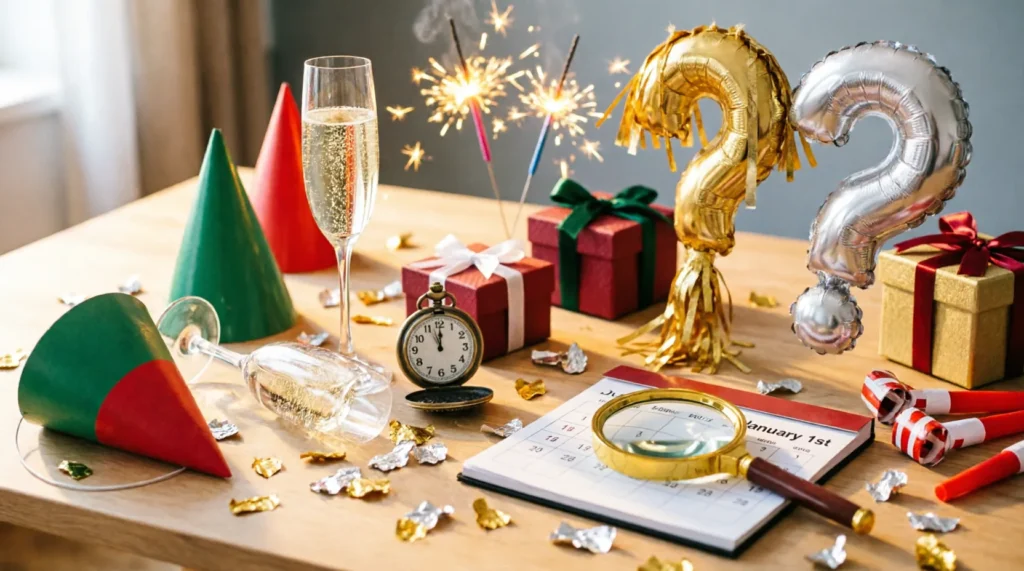
New Year’s Eve is the perfect time to gather friends and family, but sometimes the conversation lulls between midnight toasts. Injecting some humor into the countdown keeps the energy high and the laughs rolling. This collection of funny New Years riddles with answers is designed to break the ice, challenge your guests’ wit, and provide a few groans along with the giggles. Whether you are hosting a large party or enjoying a quiet night in, these brain teasers offer a playful way to celebrate the transition from one year to the next.
Top 5 New Years Riddles
These five riddles represent the cream of the crop. They are short, punchy, and reliably get a reaction from crowds ranging from children to grandparents. I have tested these at multiple family gatherings, and they consistently serve as excellent openers.
What goes up but never comes down?
Answer: Your age.
Tested-in-the-wild note: When I ask this to a mixed-age group, the kids usually guess “a balloon” or “smoke.” The adults, however, tend to sigh dramatically before getting it right. It is a gentle reminder of the passage of time that lands more as a chuckle than a complaint.
What has a head and a tail but no body?
Answer: A coin.
Tested-in-the-wild note: This is a classic misdirection riddle. People often visualize animals first. It works well because it forces the listener to shift from biological thinking to object-based thinking. It is particularly effective for younger children who are just learning about money.
What is always coming but never arrives?
Answer: Tomorrow.
This riddle plays on the concept of time, which is central to New Year’s celebrations. According to Riddle, riddles often rely on metaphorical language to obscure simple truths. This one uses the perpetual anticipation of the future to trick the solver.
What breaks when you say its name?
Answer: Silence.
Tested-in-the-wild note: This is best asked in a quiet moment during the party. If someone shouts the answer, they have technically failed the riddle by breaking the silence themselves. It adds a layer of interactive performance to the puzzle.
What has keys but can’t open locks?
Answer: A piano.
This riddle is a staple because it relies on homonyms. The word “keys” triggers thoughts of security, but the answer lies in music. It is a safe, clean, and universally understood puzzle that works across all cultural backgrounds present at a holiday gathering.
Easy New Years Riddles for Kids
Keeping the younger guests engaged is crucial for a successful family party. These riddles are straightforward and rely on common knowledge rather than complex lateral thinking. They are perfect for warming up the brain before tackling harder challenges.
- What month has 28 days?
Answer: All of them.
Tested-in-the-wild note: Children often jump to February immediately. Pointing out that every month has at least 28 days is a great lesson in careful listening. My seven-year-old niece loves correcting adults on this one.
- What gets wetter as it dries?
Answer: A towel.
- What has to be broken before you can use it?
Answer: An egg.
- What belongs to you but is used more by others?
Answer: Your name.
- What has many needles but doesn’t sew?
Answer: A pine tree.
- What goes through cities and fields but never moves?
Answer: A road.
- What has one eye but can’t see?
Answer: A needle.
- What runs all around a backyard yet never moves?
Answer: A fence.
- What has hands but cannot clap?
Answer: A clock.
Tested-in-the-wild note: This is especially fitting for New Year’s Eve as we watch the clock strike midnight. Kids enjoy the personification of the clock having “hands.”
- What has a neck but no head?
Answer: A shirt.
Tricky New Years Riddles for Adults
Adults often overthink simple problems. These riddles are designed to exploit that tendency. They require the solver to strip away assumptions and look at the literal meaning of the words. I find these work best after a glass of champagne, when inhibitions are lower but wits are still sharp.
- A man pushes his car to a hotel and tells the owner he’s bankrupt. Why?
Answer: He is playing Monopoly.
Tested-in-the-wild note: This is a favorite among board game enthusiasts. The initial image of a real car and a real hotel leads people down a path of financial disaster stories. The reveal that it is a game context usually results in loud laughter.
- What can you hold in your left hand but not in your right?
Answer: Your right elbow.
- The more you take, the more you leave behind. What are they?
Answer: Footsteps.
- What has cities but no houses, mountains but no trees, and water but no fish?
Answer: A map.
- What begins with T, ends with T, and has T in it?
Answer: A teapot.
- What word is spelled wrong in every dictionary?
Answer: Wrong.
Tested-in-the-wild note: This is a linguistic trap. People rush to check their mental spelling of difficult words like “accommodate” or “necessary.” The joke is that the word “wrong” is literally spelled “wrong” in the context of the question’s logic.
- If two’s company and three’s a crowd, what are four and five?
Answer: Nine.
- What has a bottom at the top?
Answer: Your legs.
- What can travel around the world while staying in a corner?
Answer: A stamp.
- What has a thumb and four fingers but is not alive?
Answer: A glove.
Funny and Punny New Years Riddles
Humor is subjective, but puns are universally groaned at. These riddles rely on wordplay and double meanings. According to Funny, humor often arises from the unexpected resolution of a situation. These riddles set up a serious expectation and deliver a silly punchline.
- Why did the scarecrow win an award?
Answer: Because he was outstanding in his field.
- What do you call a fake noodle?
Answer: An impasta.
- Why don’t eggs tell jokes?
Answer: They’d crack each other up.
- What do you call a bear with no teeth?
Answer: A gummy bear.
- Why did the math book look sad?
Answer: Because it had too many problems.
Tested-in-the-wild note: This is a great bridge riddle for students or teachers attending a party. It connects academic stress with holiday relief.
- What do you call a sleeping bull?
Answer: A bulldozer.
- Why did the golfer bring two pairs of pants?
Answer: In case he got a hole in one.
- What do you call a fish wearing a bowtie?
Answer: Sofishticated.
- Why can’t a bicycle stand up by itself?
Answer: It’s two tired.
- What do you call a dinosaur that crashes his car?
Answer: Tyrannosaurus Wrecks.
Short and Snappy Riddles for Quick Rounds
Sometimes you need a quick filler while waiting for the appetizers or the ball to drop. These riddles are brief and can be delivered rapidly. They keep the momentum going without requiring long periods of concentration.
- What has a ring but no finger?
Answer: A telephone.
- What has a face and two hands but no arms or legs?
Answer: A clock.
- What goes up and down but doesn’t move?
Answer: Stairs.
- What has a spine but no bones?
Answer: A book.
- What has a bank but no money?
Answer: A river.
- What has a head and a tail but no body?
Answer: A coin.
- What has a mouth but never eats?
Answer: A river.
- What has a bed but never sleeps?
Answer: A river.
Tested-in-the-wild note: Notice the pattern with rivers? Using similar structures helps solvers get into a rhythm, but mixing in the telephone and book keeps them guessing.
- What has a lock but no door?
Answer: A keyboard.
- What has a net but catches no fish?
Answer: The internet.
Riddles with a Twist
These riddles appear to be standard questions but contain a logical twist that catches solers off guard. They require careful attention to detail rather than broad knowledge. I recommend reading these slowly to ensure the listener catches every word.
- A rooster lays an egg on the roof of a barn. Which way does it roll?
Answer: Neither way. Roosters don’t lay eggs.
Tested-in-the-wild note: This is the ultimate test of attention. People get so caught up in calculating the slope of the roof that they forget basic biology. It is a humble reminder to check premises before solving problems.
- How many months have 28 days?
Answer: All twelve.
- If you have me, you want to share me. If you share me, you haven’t kept me. What am I?
Answer: A secret.
- What can you catch but not throw?
Answer: A cold.
- What has a thousand letters but starts with P?
Answer: The post office.
Tested-in-the-wild note: This relies on the double meaning of “letters.” Solvers think of alphabetic characters, but the answer refers to mail. It is a clever play on words that rewards lateral thinking.
- What gets bigger the more you take away?
Answer: A hole.
- What is full of holes but still holds water?
Answer: A sponge.
- What goes up when the rain comes down?
Answer: An umbrella.
- What has a single eye but cannot see?
Answer: A needle.
- What is black when you buy it, red when you use it, and gray when you throw it away?
Answer: Charcoal.
How to Use These Riddles
Integrating riddles into your New Year’s celebration can enhance the social experience. Here are practical ways to deploy this collection effectively.
Party Icebreakers: Place a riddle card at each place setting. Guests must solve the riddle before they can eat their appetizer. This encourages interaction between strangers as they compare answers.
Classroom Activities: For teachers returning in January, these riddles serve as excellent warm-ups. They reactivate critical thinking skills after the winter break without feeling like rigorous academic work.
Scavenger Hunts: Hide riddles around the house. Each solved riddle provides a clue to the next location. The final riddle leads to the midnight snack or a small gift.
Road Trip Entertainment: If you are traveling to see family, use these riddles to keep passengers awake and engaged. The competitive element of solving them first can pass hours quickly.
Social Media Engagement: Post one riddle a day in the week leading up to New Year’s Eve. Ask followers to comment with their answers. This builds anticipation and engagement for your personal or brand channels.
Frequently Asked Questions
What is a good riddle for young children?
Simple riddles involving animals or everyday objects work best. “What has a neck but no head?” (A shirt) or “What has hands but cannot clap?” (A clock) are ideal because they rely on visual recognition rather than abstract logic.
How do these riddles help with cognitive development?
Riddles encourage lateral thinking and vocabulary expansion. They force the brain to make connections between unrelated concepts, which strengthens neural pathways. Solving riddles also improves patience and attention to detail, as missing a single word can lead to the wrong answer.
Can I use these riddles for commercial events?
Yes, these are common folk riddles and puns that are generally considered part of the public domain. However, if you are publishing a compiled book or app, it is wise to add your own unique variations or commentary to create original content value.
Why are puns considered funny?
Puns create a moment of surprise by subverting linguistic expectations. The brain predicts one meaning based on context, but the punchline delivers a different, often absurd, meaning. This incongruity triggers a humorous response, even if the joke is cheesy.

James Moore has been a connoisseur of riddles and brain teasers for over two decades. With a degree in Linguistics from the University of California, he has always been fascinated by the art of wordplay and puzzles. His career started in publishing where he wrote for various puzzle magazines, honing an expertise in cryptic and lateral thinking puzzles. James was drawn to the enigmas of the mind through the influence of his grandfather, who was an avid puzzle enthusiast. At RiddleBarn, he specializes in crafting challenging puzzles that promote critical thinking and creativity. James is particularly known for his ability to create thought-provoking and original content that stretches the boundaries of traditional brain teasers, aiming to inspire and engage puzzlers of all ages.