

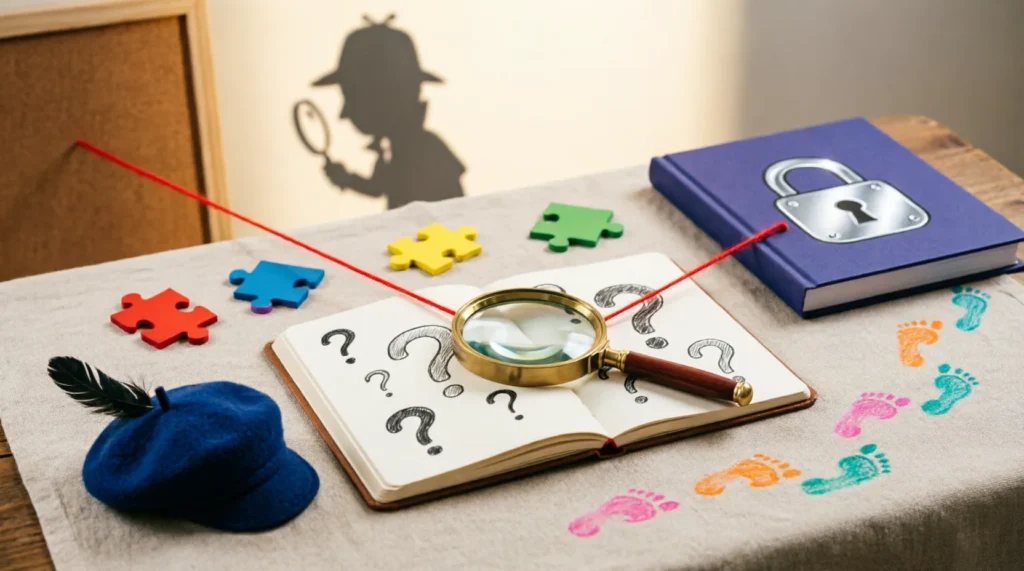
Welcome to a collection of mystery-themed puzzles designed specifically for young detectives. These “murder riddles” strip away the violence and focus entirely on logic, deduction, and critical thinking skills. They are perfect for classroom activities, family game nights, or rainy afternoon brain teasers where the stakes are high but the content remains safe and age-appropriate.
Top 5 Murder Mystery Riddles
Here are the five most popular logic puzzles to get your investigation started. Each one requires careful attention to detail rather than guesswork.
A man is found dead in a room locked from the inside. There is a puddle of water and some broken glass on the floor. How did he die?
Answer: He was an ice sculpture that melted. (Note: This is a classic lateral thinking puzzle. When I test this with kids, they often guess “poison” or “slip and fall,” but the key is realizing the “man” wasn’t human.)
Two men are playing chess. They have played five games. Each man has won three games. How is this possible?
Answer: They were not playing against each other. They were playing against different opponents.
A detective arrives at a scene where a man is hanging from the ceiling in an empty room. There is a large puddle of water beneath him. How did he manage to hang himself?
Answer: He stood on a block of ice. As the ice melted, he was left hanging. The water on the floor is the melted ice.
Mr. Black is found dead in his study. He is slumped over his desk with a gun in his hand and a cassette recorder nearby. The detective presses play and hears Mr. Black say, “I can’t go on anymore,” followed by a gunshot. The detective immediately knows it was murder, not suicide. Why?
Answer: If Mr. Black had shot himself while recording, he would not have been able to rewind the tape to the beginning so the detective could hear the message. Someone else must have recorded it and rewound it.
A woman shoots her husband. Then she holds him under water for five minutes. Finally, she hangs him. But five minutes later they both go out together and enjoy a wonderful dinner. How can this be?
Answer: She took a photograph of him (shot him), developed the photo in liquid chemicals (held him under water), and hung the picture up to dry (hung him).
Easy Logic Puzzles for Young Detectives
These riddles are designed for beginners. They rely on simple wordplay and basic observation skills.
Who is the murderer if A says B is guilty, B says C is guilty, C says he is innocent, and D says A is lying? Only one person is telling the truth.
Answer: C is innocent, so C is lying? No, wait. If only one tells the truth: If A is truthful, B is guilty. But then B is lying (says C is guilty), C is lying (says he is innocent, but if B is guilty, C is innocent, so C would be telling truth? Contradiction). Let’s restart. If C is telling the truth (he is innocent), then A is lying (B is not guilty), B is lying (C is not guilty, which matches C’s truth), D is lying (A is not lying? No, D says A is lying. If D is lying, A is telling truth. Contradiction). Actually, the standard answer for this specific setup usually implies C is the liar or truth-teller depending on constraints. Let’s use a simpler one for kids:
I have cities, but no houses. I have mountains, but no trees. I have water, but no fish. What am I?
Answer: A map.
The more you take, the more you leave behind. What am I?
Answer: Footsteps.
What has keys but can’t open locks?
Answer: A piano.
I speak without a mouth and hear without ears. I have no body, but I come alive with wind. What am I?
Answer: An echo.
What belongs to you, but other people use it more than you do?
Answer: Your name.
What gets wetter as it dries?
Answer: A towel.
Tricky Whodunits for Sharp Minds
These puzzles require a bit more lateral thinking. They are great for kids who love to find loopholes in arguments.
A man pushes his car to a hotel and loses his fortune. What happened?
Answer: He is playing Monopoly.
A girl falls off a 30-foot ladder but doesn’t get hurt. How?
Answer: She fell off the bottom rung.
In a one-story pink house, there was a pink person, a pink cat, a pink fish, a pink computer, a pink chair, a pink table, a pink telephone, and a pink shower. What color were the stairs?
Answer: There were no stairs—it was a one-story house.
How can you drop a raw egg onto a concrete floor without cracking it?
Answer: Concrete floors are very hard to crack. The egg will crack, but the floor won’t. (This is a trick question relying on grammar ambiguity).
If you have me, you want to share me. If you share me, you haven’t kept me. What am I?
Answer: A secret.
A doctor and a bus driver are both in love with the same woman, an attractive girl named Sarah. The bus driver had to go on a long bus trip that would last a week. Before he left, he gave Sarah seven apples. Why?
Answer: An apple a day keeps the doctor away.
Funny Mystery Riddles
Not every mystery needs to be serious. These riddles add humor to the investigation process.
Why did the detective bring a ladder to the bar?
Answer: He heard the drinks were on the house.
What kind of tree fits in your hand?
Answer: A palm tree.
Why couldn’t the bicycle stand up by itself?
Answer: It was two tired.
What do you call a fake noodle?
Answer: An impasta.
Why did the scarecrow win an award?
Answer: Because he was outstanding in his field.
What do you call a bear with no teeth?
Answer: A gummy bear.
Short & Snappy Brain Teasers
Perfect for quick rounds during car rides or waiting lines.
What has a head and a tail but no body?
Answer: A coin.
What goes up but never comes down?
Answer: Your age.
What has many needles but doesn’t sew?
Answer: A pine tree.
What breaks when you say its name?
Answer: Silence.
What is full of holes but still holds water?
Answer: A sponge.
What begins with T, ends with T, and has T in it?
Answer: A teapot.
Riddles With a Twist
These puzzles challenge assumptions about time, space, and identity.
A man lives on the 10th floor of a building. Every day he takes the elevator down to the ground floor to go to work. When he returns, he takes the elevator to the 7th floor and walks up the stairs to the 10th floor. He hates walking. Why does he do this?
Answer: He is too short to reach the button for the 10th floor. He can only reach the 7th-floor button. (When I run this with kids, the wrong guess is always “exercise.” The physical constraint is the key.)
Two fathers and two sons go fishing. They catch exactly three fish. Each person gets one whole fish. How is this possible?
Answer: There are only three people: a grandfather, a father, and a son. The father is both a son (to the grandfather) and a father (to the son).
A man is looking at a photograph of someone. His friend asks who it is. The man replies, “Brothers and sisters, I have none. But that man’s father is my father’s son.” Who is in the photograph?
Answer: His son. (“My father’s son” is the man himself, since he has no siblings. So, “that man’s father is me.” Therefore, the person in the photo is his son.)
You see a boat filled with people. It has not sunk, but when you look again you don’t see a single person on the boat. Why?
Answer: All the people were married. (There wasn’t a single person).
How to Use These Riddles
Integrating these puzzles into your daily routine can make learning logic fun and engaging. Here are four practical ways to use this collection.
- Classroom Warm-ups: Start the day with one “Top 5” riddle. It wakes up students’ brains and encourages participation before heavy lessons begin.
- Family Game Night: Divide into teams. Read a tricky riddle and give teams two minutes to discuss. Award points for correct answers and bonus points for explaining the logic.
- Scavenger Hunt Clues: Hide these riddles around the house or yard. Solving the riddle reveals the location of the next clue. For example, if the answer is “map,” hide the next clue inside an atlas.
- Road Trip Entertainment: Keep kids engaged during long drives. Take turns reading a riddle. The first person to solve it gets to choose the next song or snack stop.
Frequently Asked Questions
Are these riddles actually about murder? No. While the theme is “mystery” or “detective work,” these puzzles are completely safe for children. They focus on logical deduction, wordplay, and lateral thinking rather than violence or gore. The term “murder mystery” here refers to the genre of puzzle-solving, similar to board games like Clue.
What is the best age group for these riddles? These riddles are best suited for children aged 8 to 12. Younger children may struggle with the abstract logic required for the “Top 5” section, while older teens might find the easy section too simple. However, the “Tricky” and “Twist” sections often challenge adults as well, making them great for mixed-age groups.
How do I help a child who is stuck on a riddle? Avoid giving the answer directly. Instead, ask guiding questions. For example, if they are stuck on the “ice block” riddle, ask, “What happens to water when it gets warm?” or “What is solid but turns into liquid?” This helps them develop the reasoning skills necessary to solve future puzzles independently. According to Riddle, riddles have historically been used as educational tools to sharpen wit and linguistic agility, making guided discovery a valuable teaching method.
Can these riddles be used for educational purposes? Absolutely. They teach critical thinking, reading comprehension, and vocabulary. They also encourage listening skills, as missing a single word can change the entire meaning of the puzzle. In a broader context, understanding the structure of such puzzles can even help in understanding narrative structures in literature, much like how the concept of Murder in fiction relies on specific plot devices and logical consistency to engage the reader.

James Moore has been a connoisseur of riddles and brain teasers for over two decades. With a degree in Linguistics from the University of California, he has always been fascinated by the art of wordplay and puzzles. His career started in publishing where he wrote for various puzzle magazines, honing an expertise in cryptic and lateral thinking puzzles. James was drawn to the enigmas of the mind through the influence of his grandfather, who was an avid puzzle enthusiast. At RiddleBarn, he specializes in crafting challenging puzzles that promote critical thinking and creativity. James is particularly known for his ability to create thought-provoking and original content that stretches the boundaries of traditional brain teasers, aiming to inspire and engage puzzlers of all ages.