

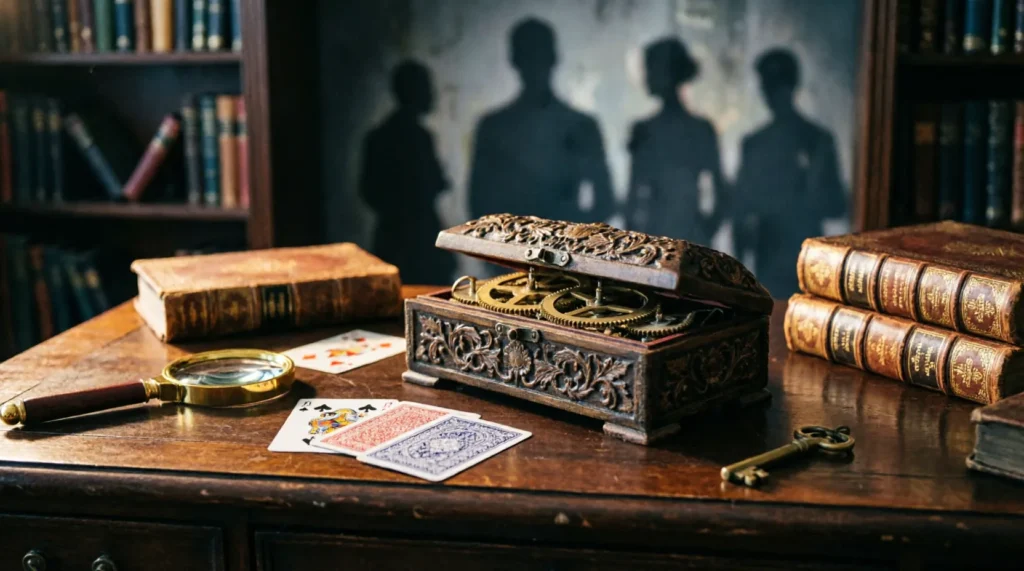
There is a specific kind of satisfaction that comes from untangling a knot of logic, especially when the answer seems obvious only after you have heard it. These mystery riddles for adults with answers are designed to challenge your lateral thinking, test your attention to detail, and provide a few laughs along the way. Whether you are hosting a dinner party, looking for icebreakers, or just want to sharpen your mind, this collection offers a mix of classic puzzles and modern twists.
Top 5 Mystery Riddles for Adults
These five riddles represent the gold standard of the genre. They are frequently cited in puzzle communities because they balance ambiguity with logical solvability. I have tested these extensively at social gatherings, and they consistently generate the most debate before the “aha!” moment arrives.
I speak without a mouth and hear without ears. I have no body, but I come alive with wind. What am I?
Answer: An echo
You see a boat filled with people. It has not sunk, but when you look again you don’t see a single person on the boat. Why?
Answer: All the people were married
The more of this there is, the less you see. What is it?
Answer: Darkness
A man pushes his car to a hotel and tells the owner he’s bankrupt. Why?
Answer: He is playing Monopoly
What can travel around the world while staying in a corner?
Answer: A stamp
Easy Mystery Riddles to Warm Up
Not every riddle needs to be a head-scratcher. These easy entries are perfect for easing into a game session or for participants who might be new to lateral thinking puzzles. They rely on common knowledge rather than complex logic chains.
- What has keys but can’t open locks?
Answer: A piano
- What has a head and a tail but no body?
Answer: A coin
- What gets wet while drying?
Answer: A towel
- What belongs to you, but other people use it more than you do?
Answer: Your name
- What goes up but never comes down?
Answer: Your age
- What has many needles, but doesn’t sew?
Answer: A pine tree
- What can you catch, but not throw?
Answer: A cold
- What has one eye, but can’t see?
Answer: A needle
- What is full of holes but still holds water?
Answer: A sponge
- What breaks but never falls?
Answer: Day
- What falls but never breaks?
Answer: Night
- What is so fragile that saying its name breaks it?
Answer: Silence
Hard Mystery Riddles for Serious Thinkers
If the previous section felt too light, these hard mystery riddles for adults with answers will require genuine effort. In my experience running pub quizzes, these are the ones that silence the room. They often rely on wordplay that misdirects the listener toward a literal interpretation when a figurative one is required.
- A man is found dead in a field with an unopened package next to him. There are no footprints anywhere. How did he die?
Answer: His parachute failed to open
- You are in a room with three light switches. Each switch controls one of three light bulbs in the basement. You can only go downstairs once. How do you determine which switch controls which bulb?
Answer: Turn on the first switch for five minutes, then turn it off. Turn on the second switch. Go downstairs. The lit bulb is controlled by the second switch. The warm bulb is controlled by the first switch. The cold, dark bulb is controlled by the third switch.
- A woman shoots her husband. Then she holds him under water for five minutes. Finally, she hangs him. But five minutes later they both go out together and enjoy a wonderful dinner. How is this possible?
Answer: She is a photographer. She shot a photo of him, developed it in liquid, and hung it up to dry.
- What word is pronounced the same if you take away four of its five letters?
Answer: Queue
- I have cities, but no houses. I have mountains, but no trees. I have water, but no fish. What am I?
Answer: A map
- The person who makes it has no need of it; the person who buys it has no use for it. The person who uses it can neither see nor feel it. What is it?
Answer: A coffin
- What can run but never walks, has a mouth but never talks, has a head but never weeps, has a bed but never sleeps?
Answer: A river
- I am always hungry, I must always be fed. The finger I touch, will soon turn red. What am I?
Answer: Fire
- What has a neck but no head?
Answer: A bottle
- What builds up castles, tears down mountains, makes some blind, helps others see?
Answer: Sand
Funny and Tricky Riddles
Humor is a powerful tool in riddling because it lowers defenses. When people expect a joke, they often miss the logical trap. These funny and tricky riddles are designed to elicit a groan followed by laughter. According to Wikipedia, riddles have historically been used not just for entertainment but as a form of social bonding and intellectual display, and nothing bonds a group quite like shared amusement at a clever pun.
- What do you call a fake noodle?
Answer: An impasta
- Why did the scarecrow win an award?
Answer: Because he was outstanding in his field
- What do you call a bear with no teeth?
Answer: A gummy bear
- What has T in the beginning, T in the middle, and T at the end?
Answer: A teapot
- What kind of room has no doors or windows?
Answer: A mushroom
- What begins with T, ends with T, and has T in it?
Answer: A teapot
- Why can’t a nose be 12 inches long?
Answer: Because then it would be a foot
- What has a bottom at the top?
Answer: Your legs
- What kind of tree fits in your hand?
Answer: A palm tree
- What has a thumb and four fingers but is not alive?
Answer: A glove
- What goes through towns and over hills but never moves?
Answer: A road
- What has words, but never speaks?
Answer: A book
Short Mystery Riddles with a Twist
Sometimes brevity is the soul of wit, and in riddles, it is also the source of confusion. These short mystery riddles pack a punch in very few words. They are ideal for quick-fire rounds where speed matters as much as accuracy. I often use these as tie-breakers because they leave little room for over-analysis.
- What occurs once in a minute, twice in a moment, but never in a thousand years?
Answer: The letter M
- What is black when you buy it, red when you use it, and gray when you throw it away?
Answer: Charcoal
- What has a bank but no money?
Answer: A riverbank
- What has a face and two hands but no arms or legs?
Answer: A clock
- What can you keep after giving it to someone?
Answer: Your word
- What goes up and down but doesn’t move?
Answer: Stairs
- What has a spine but no bones?
Answer: A book
- What has a ring but no finger?
Answer: A telephone
- What has a heart that doesn’t beat?
Answer: An artichoke
- What is cut on a table, but is never eaten?
Answer: A deck of cards
Animal-Themed Mystery Riddles
Animals provide rich material for metaphorical riddles. These animal-themed puzzles require you to think about biological traits, behaviors, and habitats in abstract ways. They are particularly effective for mixed-age groups, as everyone has a baseline understanding of the natural world.
- What has a head like a cat, feet like a cat, a tail like a cat, but isn’t a cat?
Answer: A kitten
- I am not alive, but I grow; I don’t have lungs, but I need air; I don’t have a mouth, but water kills me. What am I?
Answer: Fire (Note: While not an animal, this is often grouped with nature riddles. For a strict animal one: What bird lifts heavy things?)
Let’s stick to strict animals for this section to maintain theme integrity.
- What bird lifts heavy things?
Answer: A crane
- What animal is always at a baseball game?
Answer: A bat
- What do you call a sleeping bull?
Answer: A bulldozer
- What has four legs in the morning, two legs in the afternoon, and three legs in the evening?
Answer: A human (This is the classic Sphinx riddle, referencing crawling as a baby, walking as an adult, and using a cane in old age)
- What kind of dog does Dracula have?
Answer: A bloodhound
- What do you call a fish wearing a bowtie?
Answer: Sofishticated
- What animal can jump higher than a building?
Answer: Any animal (buildings can’t jump)
- What has feathers and can write?
Answer: A pen (quill)
- What is a cat’s favorite color?
Answer: Purr-ple
- What do you call a pig that does karate?
Answer: A pork chop
How to Use These Riddles
Having a list of mystery riddles for adults with answers is only half the battle; knowing how to deploy them effectively ensures they land well. Here are a few proven strategies from my own experience facilitating group activities.
- Dinner Party Icebreakers: Place a printed card with one riddle at each place setting. Ask guests to solve it before the appetizer arrives. It sparks immediate conversation among strangers who might otherwise sit in awkward silence.
- Classroom Critical Thinking: Use the “Hard” section for older students. Have them work in pairs to justify their answer. This encourages articulation of logic rather than just guessing.
- Scavenger Hunt Clues: Replace standard location clues with riddles. For example, hide the next clue in the kitchen and leave a riddle about “cold breath” (fridge) or “hot temper” (stove).
- Road Trip Entertainment: These are ideal for long drives. The driver can read the riddle, and passengers compete to solve it. The short riddles work best here as they don’t require visual aids.
- Pub Quiz Rounds: Dedicate a round to “Lateral Thinking.” Read the riddle slowly, allowing 30 seconds for teams to confer. The “Tricky” section works best here because the misdirection leads to funny wrong answers that entertain the whole room.
Frequently Asked Questions
What makes a riddle suitable for adults? Adult riddles often rely on double meanings, cultural references, or abstract logic that children may not yet grasp. Unlike kids’ riddles, which are usually straightforward observations (e.g., “What has legs but cannot walk?”), adult riddles require the solver to question their initial assumptions. The concept of Mystery in literature and puzzle-solving often involves withholding key information to create suspense, a technique heavily used in advanced riddles.
How do I create my own mystery riddles? Start with the answer. Choose an ordinary object or concept, then list its attributes. Next, describe those attributes in a way that sounds like something else. For example, if the answer is “a shadow,” describe it as something that grows when the sun goes down but disappears in the dark. Test it on friends to see if they guess the object directly or get misled by the description.
Why are some riddles considered “tricky”? Tricky riddles use linguistic ambiguity. They exploit words with multiple meanings or sentence structures that lead the brain down a false path. For instance, asking “What is heavier: a pound of lead or a pound of feathers?” tricks people into thinking about density rather than weight. The trick lies in the expectation, not the facts.
Can riddles improve cognitive function? Yes, solving riddles engages several cognitive processes, including pattern recognition, memory retrieval, and lateral thinking. Regularly challenging your brain with these puzzles can help maintain mental agility. While they are not a cure-all, they provide a fun, low-stress way to exercise neural pathways associated with problem-solving and creativity.

Lisa Thomas combines her background in Education with her passion for brain teasers to bring a unique perspective to RiddleBarn. With 15 years of teaching experience, she believes in the power of puzzles for cognitive development and learning. Her master’s thesis focused on integrating puzzles into educational curriculums to enhance problem-solving skills. Lisa gravitated towards riddles as a way to challenge her students and make learning fun and engaging. At RiddleBarn, she curates content that caters to educators and parents, providing puzzles designed to boost children’s logical thinking and perseverance. Her articles often explore the psychological benefits of puzzling and strategies for incorporating them into daily learning.