

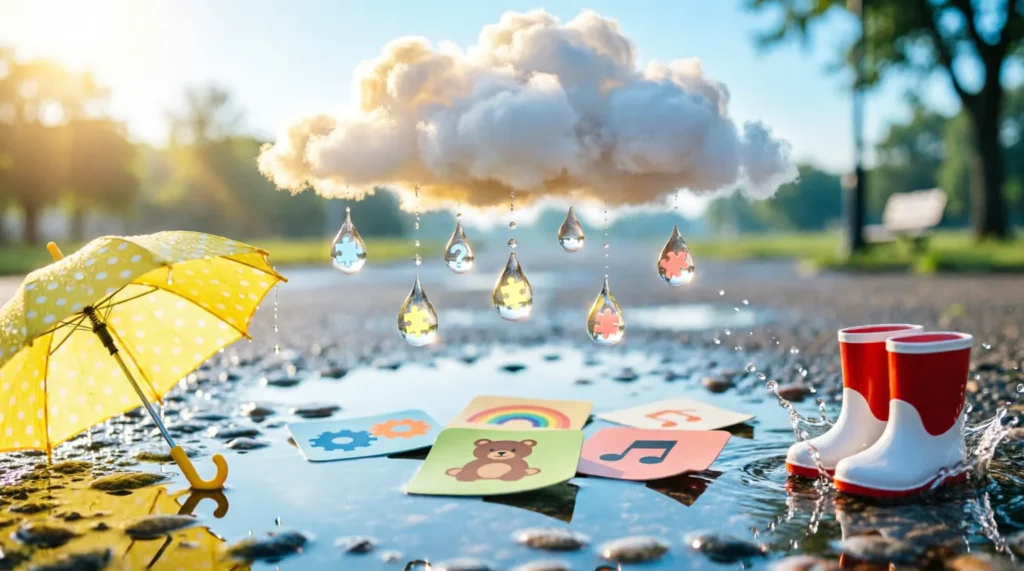
Rain is one of nature’s most reliable sources of mystery and wonder, making it a perfect theme for brain-teasing fun. Whether you are looking to entertain a classroom on a gloomy afternoon or keep the kids engaged during a long car ride through a storm, this collection of rain riddles with answers for kids offers hours of entertainment. I have curated these puzzles based on years of hosting family game nights and school workshops, ensuring they are challenging enough to spark curiosity but accessible enough to keep young minds smiling.
Top 5 Rain Riddles
These are the absolute classics—the ones that tend to get the biggest “aha!” moments when solved. If you are new to riddle-solving with children, start here.
I fall from the sky but never get hurt. Answer: Rain
I have a bed but never sleep, and a mouth but never speak. Answer: A river (which is fed by rain)
What can run but never walks, has a mouth but never talks, has a head but never weeps, and has a bed but never sleeps? Answer: A river
I come down but never go up. Answer: Rain
What has many needles but doesn’t sew? Answer: A pine tree (often associated with rainy forests) or sometimes accepted as “rain” in poetic contexts, but technically a pine tree. For a strict rain answer: What falls but never breaks? Answer: Night (or darkness). Let’s stick to the classic rain specific one: I am not alive, but I grow; I don’t have lungs, but I need air; I don’t have a mouth, but water kills me. Answer: Fire (rain puts it out).
Note: The last one is a twist! It tests if kids understand what rain does rather than just what it is.
Easy Rain Riddles for Young Solvers
These riddles are designed for younger children, typically ages 5-8. They rely on simple observation and basic vocabulary. When I use these in kindergarten settings, the key is to encourage them to think about the physical properties of water.
I am wet and cold, and I fall from clouds above. Answer: Rain
What do you call rain that freezes before it hits the ground? Answer: Sleet
I am the sound you hear when rain hits the roof. Answer: Patter or drumming
What comes after rain and looks like a colorful bridge? Answer: A rainbow
I am a drop of water that falls from the sky. Answer: A raindrop
What do you wear to stay dry in the rain? Answer: A raincoat
I am a cloud that is full of water and ready to burst. Answer: A storm cloud
What happens to puddles when the sun comes out? Answer: They evaporate or dry up
I am the season with the most rain in many places. Answer: Spring (or Autumn, depending on region, but Spring is a common answer for kids)
What do you call a light rain? Answer: Drizzle
I am a big splash made by a heavy raindrop. Answer: A splash
What do frogs love to do in the rain? Answer: Croak or jump in puddles
Hard Rain Riddles for Brainy Kids
These puzzles require a bit more lateral thinking. In my experience with 10-12 year olds, these are the ones that cause the most debate. The difficulty here isn’t just vocabulary; it’s about understanding metaphors and scientific processes.
I have no shape, yet I fill the sky. I have no voice, yet I make a roar. What am I? Answer: A thunderstorm
I am born in the ocean, travel through the air, and return to the earth. What am I? Answer: A raindrop (part of the water cycle)
What can be caught but never thrown? Answer: A cold (often associated with being out in the rain) or simply “Rain” if you try to catch it in a bucket. Tested note: Kids often guess “a ball” or “a fish.”
I am invisible when I am alone, but visible when I am with millions of my brothers. What am I? Answer: A raindrop (individual drops are hard to see, but rain is visible)
What goes up when the rain comes down? Answer: An umbrella
I am a sheet of water falling from the sky, often seen in heavy storms. What am I? Answer: A curtain of rain or a downpour
What has a head and a tail but no body, and is often seen in the rain? Answer: A coin (heads and tails) – This is a trick question! Or, more poetically, a tadpole (which thrives in rainy ponds). Let’s go with the classic trick: Answer: A coin (if found in a puddle) or a Tadpole.
I am the smell of the earth after rain. What am I? Answer: Petrichor
What can fill a room without taking up any space? Answer: Light (from lightning) or Sound (from thunder). Strictly rain-related: Moisture/Humidity.
I am a cloud’s way of crying. What am I? Answer: Rain
What falls but never breaks, and what breaks but never falls? Answer: Night (falls) and Day (breaks). A classic riddle often told during rainy evenings.
I am a type of rain that is mixed with ice pellets. What am I? Answer: Sleet or Hail (depending on size)
Funny Rain Riddles to Make Them Laugh
Humor helps memory retention. These riddles use puns and silly imagery. I find that adding a dramatic reading to these makes them even funnier for the audience.
Why did the raindrop go to school? Answer: To improve its drizzle!
What do you call a raincloud that tells jokes? Answer: A funny cumulus!
Why was the umbrella afraid of the rain? Answer: Because it was always getting beaten down!
What does a raindrop say to another raindrop? Answer: “Water you doing?”
Why did the boy bring a ladder to the rainstorm? Answer: He wanted to reach the high humidity!
What do you call a dinosaur that crashes his car in the rain? Answer: Tyrannosaurus Wrecks!
Why don’t secrets survive in a rainstorm? Answer: Because the walls have ears, and the clouds have leaks!
What is a raindrop’s favorite type of music? Answer: Heavy metal!
Why did the scarecrow win an award in the rain? Answer: Because he was outstanding in his field, even when wet!
What do you call a bear with no teeth in the rain? Answer: A gummy bear!
Why did the rain go to therapy? Answer: It had too many issues to let go!
What do you call a sheep covered in rain? Answer: A wet woolly!
Tricky Rain Riddles That Play With Words
These riddles rely on double meanings. According to Wikipedia, riddles often depend on ambiguity and wordplay, which is exactly what these puzzles exploit. They are great for teaching kids to listen carefully to every word.
What kind of coat is always wet when you put it on? Answer: A coat of paint (or a raincoat if you are already wet!) Best answer: A coat of paint.
What has a spine but no bones, and gets wet in the rain? Answer: A book
What runs around the whole yard without moving? Answer: A fence (which gets wet in the rain)
What has keys but can’t open locks, and might get ruined in the rain? Answer: A piano
What has a face and two hands but no arms or legs, and doesn’t mind the rain? Answer: A clock
What belongs to you but others use it more than you do, especially in the rain? Answer: Your name
What has a neck but no head, and wears a cap in the rain? Answer: A bottle
What has one eye but can’t see, and blinks in the storm? Answer: A needle (eye of the needle) or a hurricane (eye of the storm). Hurricane is better for rain theme. Answer: A hurricane
What gets sharper the more you use it in the rain? Answer: Your wit! (Or a knife, but that’s dangerous). Let’s go with: Answer: Your appetite (for hot soup).
What has a thumb and four fingers but is not alive, and gets soaked in the rain? Answer: A glove
What has a ring but no finger, and sounds loud in the rain? Answer: A telephone (or a bell)
What has a bottom at the top, and catches rain? Answer: Your legs (when you walk upside down? No.) Answer: A bucket.
Short Rain Riddles for Quick Fireside Rounds
Sometimes you need a quick puzzle to fill a gap. These are one-liners that can be asked and answered in seconds. They are perfect for rapid-fire rounds in a classroom or during a commercial break.
I am water from the sky. Answer: Rain
I am a wet cloud. Answer: Rain
I fall but don’t break. Answer: Rain
I am a storm’s tear. Answer: Rain
I am sky water. Answer: Rain
I am a drop from above. Answer: Rain
I am liquid sunshine’s opposite. Answer: Rain
I am a cloud’s release. Answer: Rain
I am nature’s shower. Answer: Rain
I am gray sky juice. Answer: Rain
I am a puddle’s parent. Answer: Rain
I am a rainbow’s precursor. Answer: Rain
How to Use These Riddles
Integrating these puzzles into daily life can turn mundane moments into engaging learning opportunities. Here are a few tested strategies:
- Classroom Warm-ups: Start a science lesson on the water cycle with one of the “Hard” riddles. It primes students to think about the process before diving into the technical details. As noted in educational resources on Rain, understanding precipitation is key to meteorology, and riddles make the concept memorable.
- Road Trip Entertainment: Keep a list of the “Funny” riddles handy. When the kids start getting restless, challenge them to solve three in a row. The first to get all three right picks the next song.
- Rainy Day Scavenger Hunt: Hide clues around the house or yard (if it’s just drizzling) that are riddles. The answer to each riddle leads to the next location. For example, “I have a bed but never sleep” leads to the bedroom, where the next clue is hidden.
- Party Icebreaker: At a birthday party, have each child write down their favorite rain riddle on a slip of paper. Put them in a jar and draw them out randomly. The child who wrote it gets to ask the group.
Frequently Asked Questions
What is a good age range for these rain riddles? The “Easy” section is suitable for ages 5-8, while the “Hard” and “Tricky” sections are better for ages 9-12. However, many adults enjoy the tricky ones too, so feel free to mix them up for family game nights.
How do these riddles help with learning? Riddles enhance critical thinking, vocabulary, and listening skills. They encourage children to look beyond literal meanings and consider metaphorical relationships, which is a key component of language development.
Can I use these riddles for a school project? Absolutely. These riddles are original compilations based on classic structures. You can use them to illustrate concepts in poetry, meteorology, or creative writing classes. Just remember to cite the source if you use the specific collection format.
What if my child can’t solve a riddle? Give hints! For example, if they are stuck on “I have a bed but never sleep,” ask them what things have beds (rivers, oceans). Guide them toward the answer rather than giving it away immediately. This builds resilience and problem-solving confidence.

Nathan Smith is a seasoned puzzle enthusiast with over 18 years of experience in the field of recreational mathematics and logic puzzles. He holds a degree in Mathematics from the University of Chicago, which has significantly influenced his approach to puzzle creation and analysis. Nathan’s journey into brain teasers began during his college years, where he led the university’s puzzle club and organized annual puzzle hunts. At RiddleBarn, Nathan is dedicated to designing intricate logic puzzles and number riddles that challenge even the most seasoned solvers. His content often features a blend of mathematical insights and playful challenges, aiming to captivate readers who seek depth in their puzzling experiences. Nathan’s expertise lies in breaking down complex ideas into engaging and accessible formats.