

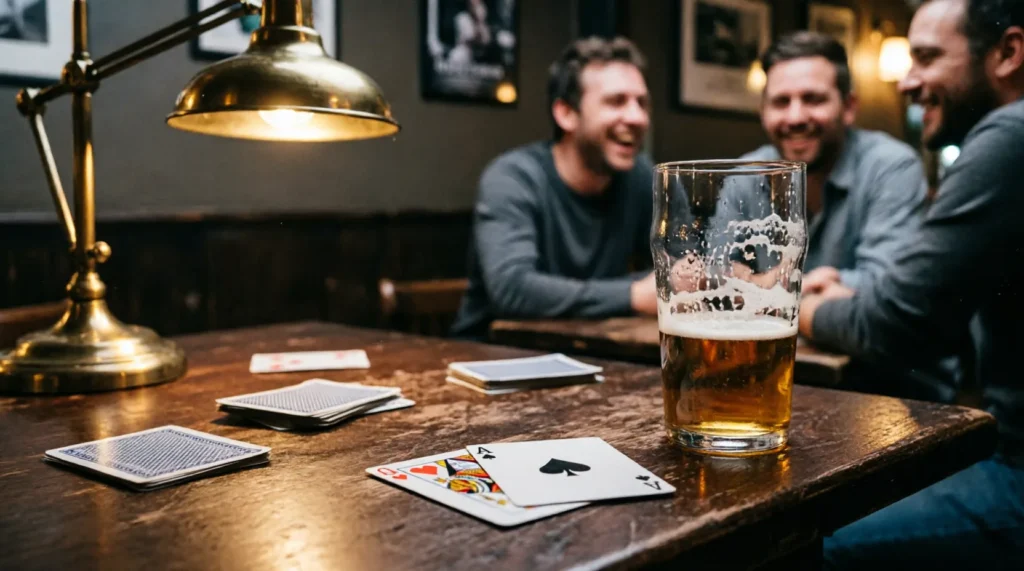
Gathering a group of friends for game night usually involves loud board games or trivia apps, but nothing gets a room laughing and arguing quite like a perfectly crafted brain teaser. This collection is specifically curated for mature minds who appreciate a good groan, a sharp twist of logic, and a punchline that sneaks up on them. Whether you are hosting a dinner party or just trying to stump your smartest friend, these puzzles will do the trick.
Top 5 Hard and Funny Riddles for Adults
- A man pushes his car until he reaches a hotel. When he arrives, he realizes he is instantly bankrupt. What happened?
Answer: He is playing Monopoly and landed on Boardwalk.
Tested in the wild: Pub quiz regulars get this instantly, but casual players will spend five minutes inventing complex stories about gas prices, flat tires, and tow trucks before the lightbulb goes on.
- You see a boat filled with people. It has not sunk, but when you look again you don’t see a single person on the boat. Why?
Answer: All the people were married.
Tested in the wild: Adults always guess “ghosts” or “they all jumped overboard,” completely missing the linguistic trick resting on the word “single.”
- What is the difference between a poorly dressed man on a unicycle and a well dressed man on a bicycle?
Answer: Attire.
Difficulty rating: This only looks hard. Once you say it out loud, the pun hits everyone in the room simultaneously. It is a fantastic icebreaker because it rewards people for listening closely rather than overthinking.
- I am a five letter word. If you remove my first letter, I am a country. If you remove my first two letters, I am the opposite of the word. What am I?
Answer: Woman (Remove ‘W’ for Oman, remove ‘Wo’ for man).
Tested in the wild: This is genuinely hard. My trivia team stared at a whiteboard for ten minutes before someone jokingly guessed it and realized it was actually correct.
- What invention lets you look right through a wall?
Answer: A window.
Difficulty rating: Deceptively simple. People immediately look for complex sci-fi technology or x-ray specs when the answer has been in their living room the whole time.
Tricky Wordplay Riddles
a riddle is a statement, question or phrase having a double or veiled meaning, put forth as a puzzle to be solved. Wordplay is the oldest form of this puzzle, and it remains the most satisfying when you finally crack the linguistic code.
- What begins with an E and ends with an E but only has one letter in it?
Answer: An envelope.
- I am a box that holds keys without locks, yet they can stir your soul. What am I?
Answer: A piano.
- What has a neck but no head?
Answer: A bottle.
- Forward I am heavy, backwards I am not. What am I?
Answer: Ton (spelled backwards is Not).
- I have cities, but no houses. I have mountains, but no trees. I have water, but no fish. What am I?
Answer: A map.
- What can you hold in your right hand, but never hold in your left hand?
Answer: Your left elbow.
Tested in the wild: Watching people physically try to grab their own left elbow with their left hand is the best part of running this one at a party. It turns a mental puzzle into immediate physical comedy.
- What word in the English language does the following: the first two letters signify a male, the first three letters signify a female, the first four letters signify a great, while the entire word signifies a great woman?
Answer: Heroine (He, Her, Hero, Heroine).
- I am a box that holds your breath, though I have no lungs. What am I?
Answer: A mask (or a lung, depending on how literal you want to be, but mask is the classic answer).
Funny Logic and Lateral Thinking Riddles
These rely less on vocabulary and more on breaking your assumptions. The trick is to stop thinking like a mathematician and start thinking like a comedian who is actively trying to trick you.
- Why can’t a man living in New York be buried in California?
Answer: Because he is still living.
Tested in the wild: 9 out of 10 people miss the “living” part and start talking about state laws, cross-country transportation costs, or cemetery plots.
- A rooster lays an egg on the peak of a triangular roof. Which side does it roll down?
Answer: Neither side. Roosters don’t lay eggs.
- If it takes 5 machines 5 minutes to make 5 widgets, how long would it take 100 machines to make 100 widgets?
Answer: 5 minutes.
Tested in the wild: The math-brained folks at my table always confidently yell “100 minutes!” before realizing that each individual machine takes exactly 5 minutes to make one widget.
- How can a man go eight days without sleep?
Answer: He sleeps at night.
- A cowboy rides into town on Friday, stays for three days, and leaves on Friday. How did he do it?
Answer: His horse’s name is Friday.
- You are running in a race and you pass the person in second place. What place are you in?
Answer: Second place.
Difficulty rating: Genuinely tricky. The human brain desperately wants to say “first place,” making this a perfect quick-fire trap for competitive friends.
- If an electric train is traveling south, which way is the smoke blowing?
Answer: There is no smoke; it is an electric train.
Math and Number Riddles for Grown-Ups
Numbers can be just as deceptive as words. These require you to step away from standard algebra and look at the physical properties of the digits themselves.
- I am an odd number. Take away a letter and I become even. What number am I?
Answer: Seven (remove the ‘s’ and it becomes ‘even’).
Tested in the wild: Math teachers love this one because it brilliantly bridges the gap between numerical logic and linguistic trickery.
- A bat and a ball cost $1.10 in total. The bat costs $1.00 more than the ball. How much does the ball cost?
Answer: 5 cents. (If the ball is $0.05, the bat is $1.05, which is exactly $1.00 more).
Difficulty rating: Genuinely hard for the intuition. The cognitive reflection test shows most adults instantly blurt out “10 cents” without doing the basic algebra required to check their work.
- If you multiply this number by any other number, the answer will always be the same. What number is this?
Answer: Zero.
- I am a three-digit number. My tens digit is five more than my ones digit. My hundreds digit is eight less than my tens digit. What number am I?
Answer: 194.
- How many months have 28 days?
Answer: All 12 of them.
- What is the next number in this sequence: 1, 11, 21, 1211, 111221?
Answer: 312211. (This is the “look and say” sequence where you describe the previous number out loud).
Short and Snappy Brain Teasers
When you need to keep the pace moving, short riddles are your best friend. They are easy to memorize and rapid-fire at a crowded table when the drinks are flowing and attention spans are shortening.
- What has words, but never speaks?
Answer: A book.
- What runs around the whole yard without moving?
Answer: A fence.
- What goes up but never comes down?
Answer: Your age.
- What can you catch, but not throw?
Answer: A cold.
- What has many teeth, but cannot bite?
Answer: A comb.
- What building has the most stories?
Answer: A library.
- What gets broken without being held?
Answer: A promise.
- What goes through cities and fields, but never moves?
Answer: A road.
- What has a bottom at the top?
Answer: Your legs.
Sarcastic and Anti-Joke Riddles
Humor evolves as we mature. Adults often prefer riddles that subvert expectations or rely on sarcasm, which requires a more developed understanding of social norms and linguistic nuance. These are designed to make your friends roll their eyes and then chuckle at their own gullibility.
- What is red and bad for your teeth?
Answer: A brick.
Tested in the wild: This one always gets a collective groan followed by a loud laugh from the pub crowd because it entirely breaks the rules of what a riddle should be.
- Why did the old man fall in the well?
Answer: Because he couldn’t see that well.
- What do you call a magic dog?
Answer: A labracadabrador.
- Why do seagulls fly over the ocean?
Answer: Because if they flew over the bay, we’d call them bagels.
- What is brown and sticky?
Answer: A stick.
Tested in the wild: People overthink this one looking for a complex food item or a deep metaphor, but the literal, physical answer is the correct one.
- Why don’t skeletons fight each other?
Answer: They don’t have the guts.
- What do you call a fake noodle?
Answer: An impasta.
- What is a shark’s favorite game to play in the water?
Answer: Swallow the leader.
How to use these riddles
- Pub Trivia and Game Nights: Write the harder ones on slips of paper and put them in a jar. Have guests draw one and act as the “riddle master” for the table, doling out hints if the room gets too quiet.
- Road Trips: The short and snappy section is perfect for the driver to shout out to keep passengers awake and engaged during long, monotonous stretches of highway.
- Dinner Party Menus: Print a few of the funny logic puzzles on the back of your physical dinner menus. It gives guests something interactive to do while they wait for their appetizers to arrive.
- Scavenger Hunts: Hide the answers around the house or neighborhood. Give guests the riddle text, and they have to find the physical object (like a map, a comb, or a book) to get their next clue.
Frequently Asked Questions
What is a good riddle for adults? A good adult riddle avoids childish tropes and instead relies on clever wordplay, lateral thinking, or an unexpected punchline. The best ones feel like a mini-comedy routine where the punchline is a logical deduction rather than just a silly joke.
How do these riddles work? Most brain teasers work by exploiting cognitive biases. Your brain naturally fills in missing information based on past experiences (like assuming a rooster can lay an egg or that a man traveling is driving a car). The riddle forces you to step back and look at the literal words rather than the assumptions you layered on top of them.
Why are some riddles funny while others are just hard? Hard riddles usually rely on obscure vocabulary or complex math. Funny riddles rely on subversion. When your brain builds up tension trying to solve a complex puzzle, and the answer turns out to be a simple pun or an anti-joke, the sudden release of tension results in laughter.
Can I use these riddles for team-building at work? Absolutely, but choose your audience carefully. The funny logic and lateral thinking riddles are excellent for corporate icebreakers because they encourage out-of-the-box problem-solving without being inappropriate. Just skip the sarcastic or dark humor section unless you know your office culture well!

James Moore has been a connoisseur of riddles and brain teasers for over two decades. With a degree in Linguistics from the University of California, he has always been fascinated by the art of wordplay and puzzles. His career started in publishing where he wrote for various puzzle magazines, honing an expertise in cryptic and lateral thinking puzzles. James was drawn to the enigmas of the mind through the influence of his grandfather, who was an avid puzzle enthusiast. At RiddleBarn, he specializes in crafting challenging puzzles that promote critical thinking and creativity. James is particularly known for his ability to create thought-provoking and original content that stretches the boundaries of traditional brain teasers, aiming to inspire and engage puzzlers of all ages.